













Commercial leasing and investment volumes increase; luxury residential market on upward velocity
Hong Kong – April 13, 2026 – Despite ongoing macroeconomic and geopolitical uncertainties, Hong Kong’s real estate market demonstrated notable resilience in the first quarter of 2026. Leasing activity was seasonally slow across sectors; however, professional investors became more active this quarter, reversing the trend observed in recent periods. Additionally, the market demonstrated strong demand for luxury residential properties, supported by lower mortgage rates and a steady influx of high earners.
“While global economic headwinds and policy adjustments continue to shape near-term market conditions, Hong Kong’s real estate market has entered 2026 on a more constructive footing,” said Marcos Chan, Executive Director, Head of Research, CBRE Hong Kong. “We are observing increased confidence across various sectors, fueled by the strengthening financial market fundamentals in Hong Kong, renewed demand from both traditional and emerging industries, and the return of professional investors to the market.This positions the market for a gradual and sustainable recovery over the medium term.”
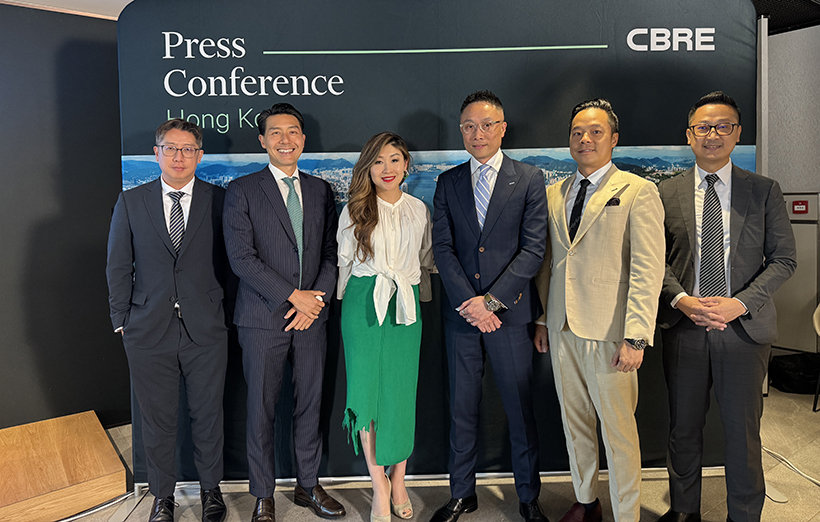
Spokespersons (from left to right) in the attached photo:
Lawrence Wan,Head ofRetail Leasing, CBRE Hong Kong
Samuel Lai, Head of Industrial & Logistics, CBRE Hong Kong
Ada Fung, Chief Operating Officer, Advisory Services, CBRE Hong Kong
Marcos Chan, Head of Research, CBRE Hong Kong
Reeves Yan, Head of Capital Markets, CBRE Hong Kong
Eddie Kwok,Executive Director, Valuation & Advisory Services, Hong Kong
Snapshot
- Grade A Office Leasing Market: Central saw significant improvement in leasing demand, resulted in lower vacancy and strong rental growth. This is in sharp contrast to decentralised submarkets, where rents continued falling.
- Retail Leasing Market: Retail leasing was seasonally slow in Q1 2026, but robust retail sales and tourist arrivals growth ensured retailers with exposure in tourist hotspots remained largely upbeat. Healthy occupancy continued to support modest rental growth during the quarter.
- Industrial & Logistics Leasing Market: Landlords’ increased flexibility in rents helped improve occupancy this quarter. The negative net absorption trend reversed to result in a marginal decline in overall warehouse vacancy. Rents remained on the fall.
- Capital Markets: For the first time in a few quarters, professional investors registered a bigger share in transaction volume than end-users, signalling a gradual recovery in investment market sentiment. In addition to the sustained interests in living sector assets, end-users and local long-term investors were eager to acquire heavily-discounted office properties.
- Luxury Homes: Riding on improved market sentiment, Hong Kong’s luxury residential sector recorded robust momentum, with transactions above HK$100 million surging 156% year-on-year in Q1 2026. The latest stamp duty increase announced in the Budget is expected to have only a limited impact on this high-end segment.
Grade A Office
- Net absorption reached 375,400 sq. ft., a fourth consecutive positive quarter. Over the past four quarters, total net absorption has totalled 2.7 million sq. ft.. Central reported 162,900 sq. ft., marking its fifth consecutive quarter of positive net absorption, fueled by improved occupancy in both the Grade A1 and non-A1 segments. Greater Tsim Sha Tsui logged -45,600 sq. ft., its first negative figure since Q4 2024. Kowloon East experienced negative net absorption as tenants returned previously occupied space after relocating to new offices.
- This quarter’s lack of new supply combined with positive net absorption saw vacancy drop 0.4-ppt. to 16.8%, the biggest decline since Q2 2015.
- Overall rents increased 1.6% quarter-on-quarter, their strongest growth since Q3 2018. Growth was mainly driven by Central (5.9% quarter-on-quarter) and Greater Tsim Sha Tsui (0.9% quarter-on-quarter). Rents in Grade A1 buildings in Central reported their fastest rental growth since Q3 2010, up by 12.1% quarter-on-quarter. Rents in all major decentralized submarket continued to decline.
Ada Fung, Chief Operating Officer, Advisory Services, CBRE Hong Kong: “Although new leasing momentum was seasonally slow in Q1 2026, selective submarkets continued to see strengthening occupier demand for high-quality buildings. Banks and financial services companies were particularly active, looking for flight-to-quality and upgrading options. Net absorption stayed firmly positive for the fourth straight quarter, highlighting the robust demand for prime office space. Grade A1 buildings in Central registered their sharpest quarterly rental growth since Q3 2010, as many are running at low single-digit vacancy levels. For the following two quarters, we expect leasing volume to improve from Q1 as the city’s wealth management and insurance sector continues to expand.”
Retail
Market fundamentals strengthened in Q1 2026, with visitor arrivals up 18.4% year-on-year in January and February combined, an increase from 12.7% in Q4 2025. Retail sales in January rose by 5.5% year-on-year, following 6.6% year-on-year growth in Q4 2025 and 0.3% in Q3 2025.
•
Leasing volume in core districts declined on a quarter-on-quarter basis due to seasonal factors but increased year-on-year, with 214,000 sq. ft. of space newly leased this quarter. The F&B sector leased 43% less space quarter-on-quarter, accounting for just 35% of total volume, its lowest share in four quarters. Fashion brands were the second most active trade, leasing 22% of total volume, the highest since Q4 2016. Only handful of transactions were recorded by other trades.
•
While vacancy for high street shops in core retail districts increased slightly by 1.0-ppt quarter-on-quarter to 6.8%, this remained the second lowest figure since Q1 2024. Low vacancy pushed up rents by 0.9% quarter-on-quarter, marking a fifteenth consecutive quarterly increase.
Lawrence Wan, Executive Director, Head of Retail Leasing, CBRE Hong Kong: “Despite persistent economic headwinds, Hong Kong’s retail and tourism markets continued to show strong resilience. Consumer spending in Hong Kong has become increasingly experience-driven. Many retail brands, especially international luxury ones, are consolidating their footprints into fewer, but larger stores in prime districts to strengthen brand storytelling and customer engagement. This led to low vacancy rate at Tier 1 streets in prime retail districts. Coupled with Northbound consumption, Chinese brands are more acceptable to Hong Kong people. Apart from Chinese F&B and electric cars expansion in last few years, we are seeing more Chinese fashion brands, beauty brands and financial securities exploring retail opportunities in different locations in Hong Kong.”
Industrial
Aggregate trade increased by 31.9% year-on-year in January-February 2026, following a 15.5% increase in 2025. Container throughput declined by 5.4% year-on-year in January-February but air cargo throughput rose by 8.1% during the same period.
•
New leasing volume for Q1 2026 totalled 682,800 sq. ft., a rise of 17.4% year-on-year. Logistics companies, driven by electronics sector demand, accounted for 31% of volume. Major leasing transactions included supermarket group leasing 95,200 sq. ft. at Hutchison Logistics Centre in Kwai Chung, and an overseas building materials supplier taking 68,700 sq. ft. at Jing Hin Godown in Yuen Long.
•
Warehouse vacancy shrank by 0.3-ppt quarter-on-quarter to 12.8%, indicating positive net absorption of 135,800 sq. ft. and marking an end to four consecutive quarters of net withdrawal. Despite lower vacancy, warehouse rents fell by a further 1.2% quarter-on-quarter as landlords cut rates to improve occupancy. This marked the ninth consecutive quarterly rental decline and brought the total contraction in percentage terms from the peak achieved in Q4 2023 to 13.7%.
Samuel Lai, Executive Director, Head of Industrial & Logistics, CBRE Hong Kong: “Landlords’ willingness to adjust their rental expectations has proven effective, as warehouse net absorption has returned to positive territory for the first time since Q4 2024. Uncertainties in the global trade market and rising oil prices are prompting logistics operators to be more cautious about their overhead costs. As a result, leasing sentiment is expected to remain cautious in the coming months. However, the need to upgrade facilities for long-term business growth and improved efficiency will continue to drive demand for high-spec warehouses. This demand is less likely to be influenced by short-term market fluctuations, especially from e-commerce operators, who will be the most notable source of this demand.”
Capital Markets
The U.S. federal funds rate remained steady throughout Q1 2026, with uncertainties about further rate cuts for the remainder of the year. The benchmark 1M-HIBOR dropped from 3.08% on December 31, 2025, to 2.28% on March 30, 2026. This decline helped improve the negative yield carry associated with some commercial properties in Hong Kong.
Investment volume* grew 105% year-on-year to HK$12.3 billion in Q1 2026 despite falling 43% quarter-on-quarter from the previous quarter’s high base. Activity was driven by educational institution and end-user demand.
•
Strong owner-occupier demand ensured offices remained the most active sector, representing 53% of investment volume. Major end-user transactions included the University of Hong Kong acquiring an office
CBRE Press Release
building at 92-103A Connaught Road West in Sheung Wan for HK$3.8 billion, and Dah Sing Bank purchasing 10 floors of Viva Place in Wong Chuk Hang for HK$839 million.
•
Hotel investment gained traction this quarter as institutional investors targeted student hostel conversion opportunities. Centaline Investment bought Regal Oriental Hotel in Kowloon City for HK$1.5 billion, while CR Longdation acquired Hotel COZi ‧ Oasis in Kwai Chung for HK$954 million.
•
The number of transactions* this quarter increased by 26% year-on-year to 29. 14 deals involving financially stressed assets changed hands for HK$8.7 billion as sizeable discounts succeeded in luring private investors and developers.
Reeves Yan, Executive Director, Head of Capital Markets, CBRE Hong Kong: “Signs indicate the gradual return of professional investors, and if this trend continues, it suggests a higher investment volume in the future. In addition to the opportunistic demand from local end-users and long-term investors for heavily discounted assets, professional investors, including some property funds, have continued to focus on growth opportunities in the education sector. There is increasing interest in hotels and residential blocks that can be converted into student accommodation, as well as other commercial facilities that can be legitimately used for educational purposes. This trend is expected to persist throughout this year. ”
Luxury Residential
Macroeconomic recovery, lower interest rates and policy support boosted investment sentiment and market stability. Luxury residential of over HK$100 million transactions reached 241 transactions in 2025, a four-year high.
•
The positive sentiment persisted in Q1 2026 from both price and transaction volume. According to the Rating and Valuation Department, the price index of Class E residential properties (saleable area of 1,722 sq. ft. or above) rose 7% in February 2026 from the historic low in March 2025. The number of transactions of luxury homes of over HK$100 million has surged by 115% year-on-year in Q1 2026.
•
Mainland Chinese buyers continued to play an increasingly prominent role in the Hong Kong residential market throughout 2025, reaching new historical highs in both transaction volume and value. Mainland individuals completed 13,906 primary and secondary transactions totaling HK$137.9 billion, representing a year-on-year increase of 14% in volume and 4% in value.
•
Rise in stamp duty on homes over HK$100 million, as announced in the Budget, will have limited impact on luxury residential market, with a possible short-term dip in transaction volume, in particular on primary sales market.
•
Price of luxury home segment is expected to increase 0-5% in 2026.
Eddie Kwok, Executive Director, Valuation & Advisory Services, CBRE Hong Kong: “Hong Kong’s luxury residential market has sustained its positive momentum from 2025, with both prices and transaction volumes showing strong growth. While the latest stamp duty adjustment may lead to a brief slowdown in primary sales activity, we expect its impact on the high-end segment to remain limited, given resilient demand from both local and mainland buyers. Looking ahead, continued capital rotation, rising participation from mainland Chinese buyers and improving liquidity are expected to continue to support the luxury residential market this year.”