












Over 12,000 Visits Exploring New Opportunities in Digital Implementation Together
Hong Kong • 25 June 2026 – The CIC Global AI and Smart Construction Conference and Exhibition (GASCCE) 2026 jointly organised by the Construction Industry Council (CIC) and the Development Bureau (DEVB), marked a great success today at the Hong Kong Science Park.
The two-day event attracted more than 12,000 participants and visits onsite and online, bringing together leading experts from Hong Kong, Chinese Mainland, and overseas to exchange forward looking insights, explore the potential of digitalisation in construction, and lay a solid foundation for innovation and digital transformation in the industry.
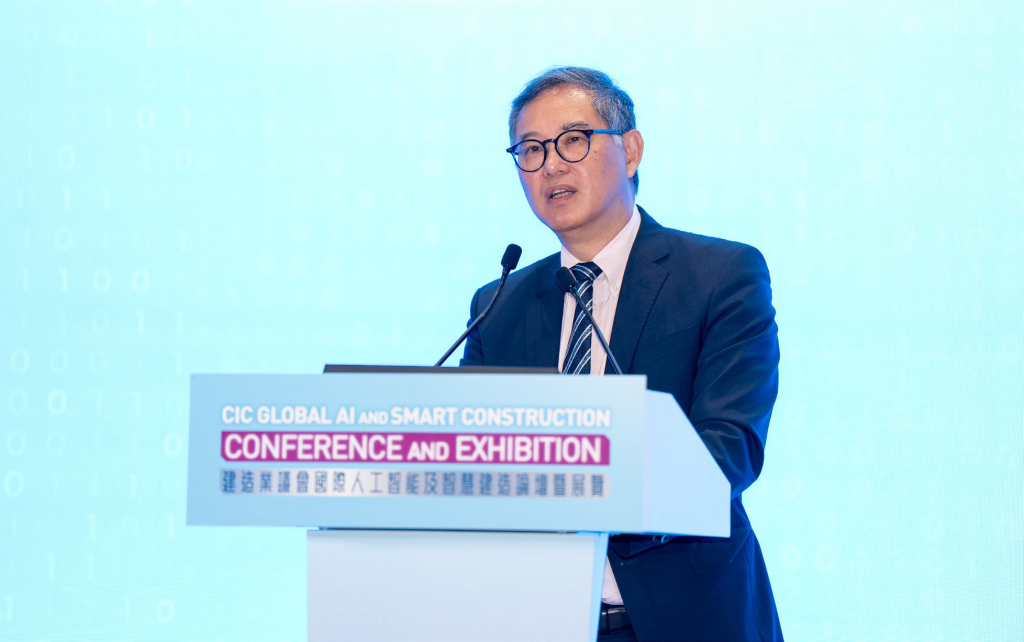
The event featured more than 40 distinguished speakers from Hong Kong and abroad, generating enthusiastic responses. The first day of the Exhibition and the “Conference on Artificial Intelligence” drew an enthusiastic response. Coming into the second day, the “Conference on Robotics & Low-altitude Economy (LAE)” focuses on the application and development of robotics in construction. Ir Prof. Thomas HO, Chairman of the CIC, said in his welcome speech, “Robotics and low-altitude applications are no longer experimental concepts, but are becoming practical tools that are reshaping how construction is delivered, inspected and managed. With the Government’s support, the growing industry adoption and continued funding investment in innovation and training, Hong Kong is well positioned to accelerate the deployment of smart construction technologies and build a safer, more productive and future-ready construction industry, shaping the next chapter of smart construction.”
The morning session also featured opening remarks by Ir Ricky LAU, the Permanent Secretary for Development (Works) of the Development Bureau (DEVB). He said, “The DEVB has been proactively fostering innovation in public works. A technical circular was issued earlier mandating suitable public works projects to adopt specified highly effective AI applications during the design, tender, and construction stages. Furthermore, construction robots have been widely adopted in public works projects to enhance on-site work efficiency, cost-effectiveness, site safety, and work quality. We are piloting the use of drones in material transportation as well as the inspection of slopes and buildings, etc. Looking ahead, I encourage all construction professionals to seize the opportunities and drive the transformation towards a digital future.”
In the afternoon, the “Conference on Robotics & LAE” continued to spark insightful discussions on the application of drones and related technologies in smart construction. Legislative Council Member Hon Elizabeth QUAT also shared the development prospect of LAE in Hong Kong in her opening address.
GASCCE centred on three core technology themes — Artificial Intelligence, Robotics, and Low-altitude Economy. The Exhibition showcased over 50 technology-related exhibitors from local and overseas markets, presenting solutions in design optimisation, construction safety, site monitoring, asset management, operations and maintenance, and intelligent decision making, comprehensively illustrating how AI is reshaping construction practices.
To conclude the GASCCE, Prof. Jack CHENG, Chairperson of the GASCCE Organising Committee, said, “Over the past two days, GASCCE has clearly demonstrated that technologies such as AI, robotics and the LAE are moving from concept into practice, and are gradually being integrated across the entire construction lifecycle. Looking ahead, the key to the future development of the construction industry lies in driving technological integration and strengthening collaboration among government, industry, academia, research and investment, so as to translate innovation into practical and scalable smart construction solutions, and to continue driving the transformation and upgrading of the industry.”
Looking forward, Ir Albert CHENG, Executive Director of the CIC, reiterated the continuous goals of the CIC, “Our role is to turn momentum into capability and adoption. We advance this through three areas: talent development, equipping the workforce with practical digital and AI skills; industry platforms, fostering collaboration and solution exchange; and funding support, providing assistance via the Construction Innovation and Technology Fund, to adopt technologies while strengthening overall industry competitiveness.
The CIC will continue to prioritise innovation and technology, deepen the integration of AI, robotics, and low altitude economy into construction, and promote cross sector collaboration and international exchange. The CIC also plans to enhance training and research initiatives, equipping industry professionals with new technological skills to improve safety, asset management efficiency, and intelligent decision making, thereby injecting sustained momentum into the sustainable development of Hong Kong’s construction industry.