








The way we work has changed. In a similar way to how homes and hotels have become more alike, offices are now becoming spaces where moments happen, and where comfort and collaboration are key.
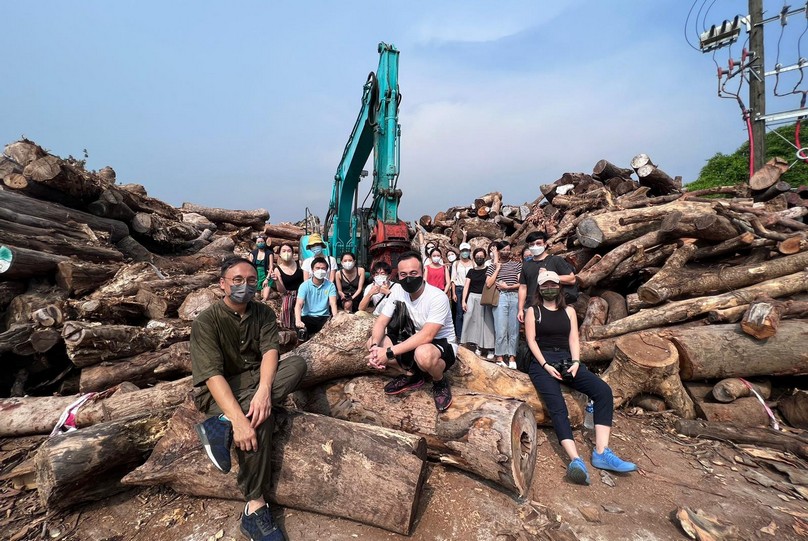
The conversation for The Scents and the Soil was sparked during our ongoing search for sustainability collaborators, where we met Ricci Wong, the founder of HK_The Oval Partnership
Information & Images: The Oval Partnership
These were driving factors for the Oval Partnership in its recent completion of the two main offices for top-tier Hong Kong developer Hang Lung Properties. ‘There’s been an ongoing office evolution across generations. These are what we call third-generation offices,’ says Project Director and design lead Justin Lau.
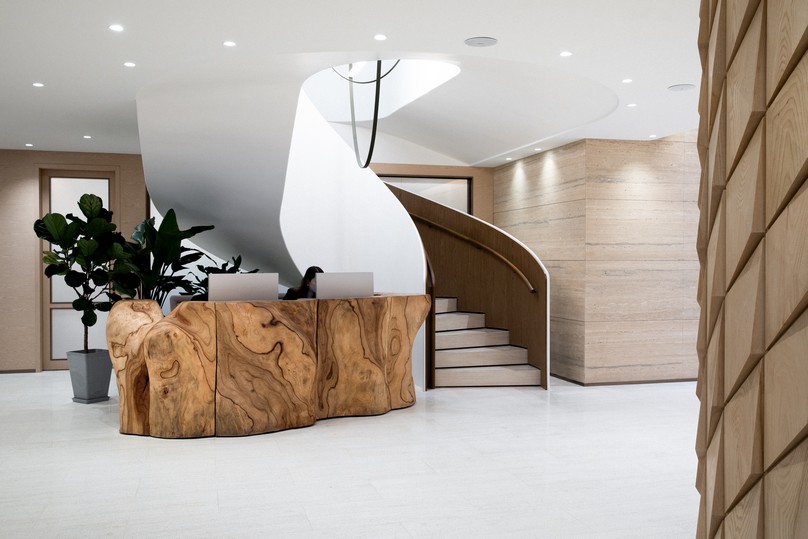
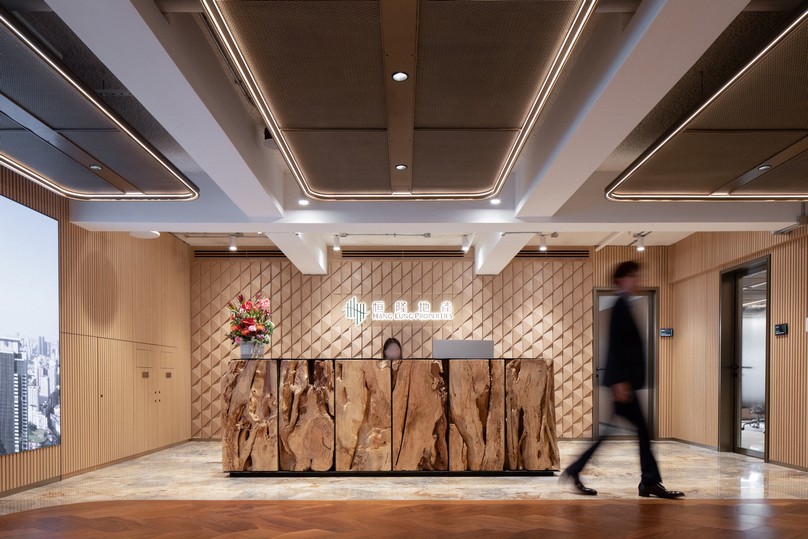
The concierge desk is a unique accent piece, and a delicate counterpoint to the solidity of the structures around it
Fresh Approach
Hang Lung’s brief centred on fostering collaboration and creativity, showing care for its staff and embodying sustainability. These principles informed every aspect of the design, from space planning to material selection, with both offices carefully designed to support a highly people-centric and collaborative work approach. The design team optimised the spaces to add features and touches more associated with a hospitality environment — these work to make people a part of the space, and help them to feel comfortable throughout different phases of the working day. Atmospheric quality and material quality were two pillars of the design, with the team wanting to foster a space where people could interact and experience feelings.
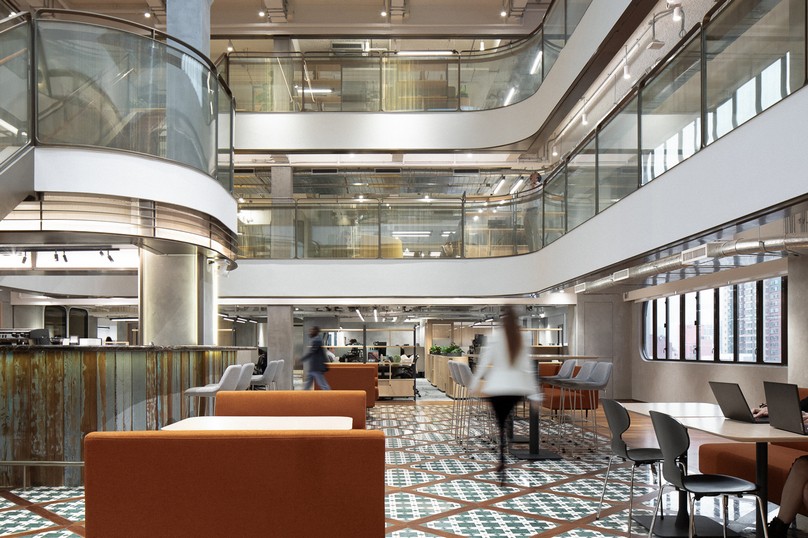
The Oval Partnership has designed two offices for Hang Lung that bring the company’s teams together in human-centric, collaborative spaces
Given that the major structural and spatial planning was in place when the Oval Partnership commenced work, the design team drew on its long experience of placemaking in public spaces with existing structures. ‘We used some of the same principles,’ says Lau. ‘We looked at it from the bottom up, considering things like visual permeability and natural light. And storytelling is always a major element.
In Hang Lung’s case, they wanted finesse and rejuvenation, so we looked at the plans in terms of a story that would resonate with them and their culture, that was aesthetically pleasing, and that would work in a very functional sense.’
The placemaking approach is highly suited to a collaborative environment, as it emphasises relationships and ‘nodal points’, similar to a lattice-like structure where many relationships and interactions are happening at the same time. ‘We aimed to bring things together at these nodal points,’ says Lau. Here, that led to ideas such as recreating the standard coffee table to generate conversations, and adding horizontal ledges and charging points to walls for people to put their coffees and work together. ‘We made opportunities for interactions,’ says Lau.
Our approach to the sustainability requirement sees both spaces prioritise recycled, reused and upcycled materials as well as sustainable choices such as bamboo, in addition to a design process that aimed to minimise waste at every step. The reception desks at each office stand out, with each being crafted from salvaged tree trunks. This holistic approach helped Hang Lung to achieve positive outcomes in its third-party RESET project assessment, which includes elements such as carbon embodiment and circularity.
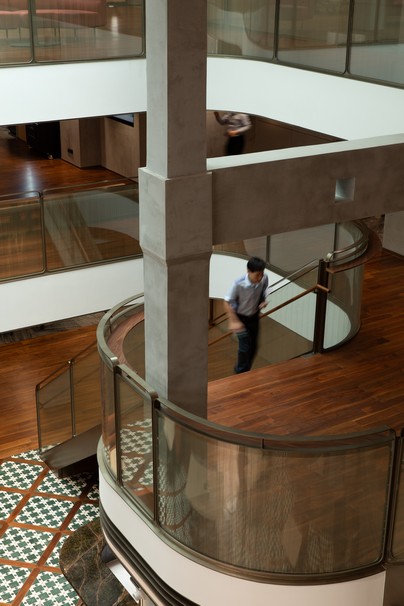
The central structural pillar of the atrium features an honest finish that embodies the enduring memory of Hang Lung’s continuous evolution_HDP Photography 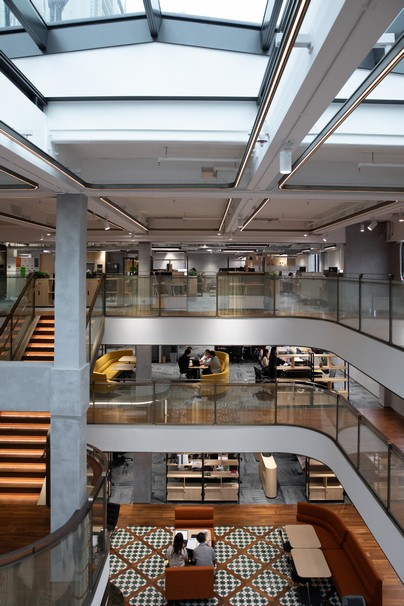
The counter is made of wood salvaged from the building’s original water tower. A skylight above lets in ample natural light_HDP Photography
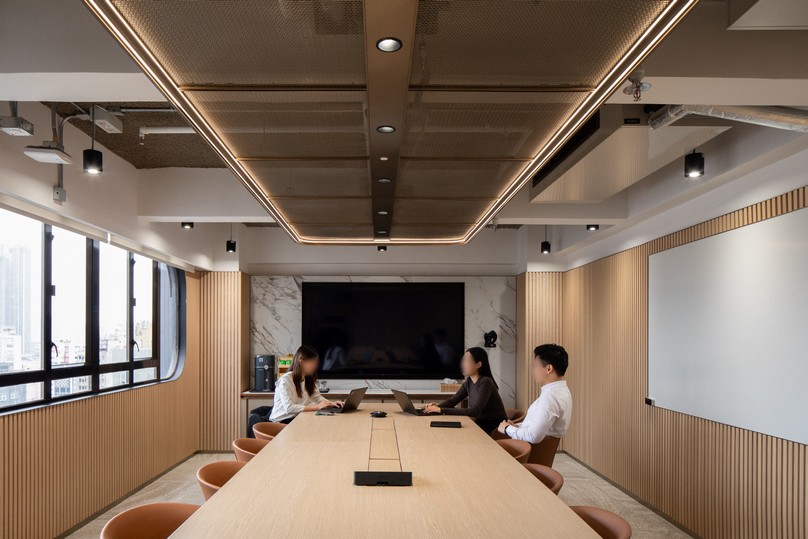
Meeting spaces echo the overall approach, with natural, craft-focused elements such as wood combining with tech for collaboration_HDP Photography
A New Look for the Standard Chartered Bank Building
The extensive lobby and reception space at Hang Lung’s head office in the Standard Chartered Bank Building is a key touchpoint between team members, and between Hang Lung and its collaborators and clients.
Here, the central area of the ceiling is formed of a sculptural slatted baffle created with dozens of individually shaped pieces of undulating bamboo. This provides a striking visual anchor while helping to dampen sound in the voluminous space. The design team placed this slightly off-centre so as to enhance the lighting effects. Below, a meeting space mirrors the baffle’s ovoid shape, with the slats breaking the ceiling form and bringing openness to collaborations.
The informal but professional ambience, with a pleasing balance between open and private, creates a Scandinavian feel throughout the space. Sustainability is integrated in a creative way that enhances the storytelling, partly through the use of bamboo and notably in the reception and concierge desk.
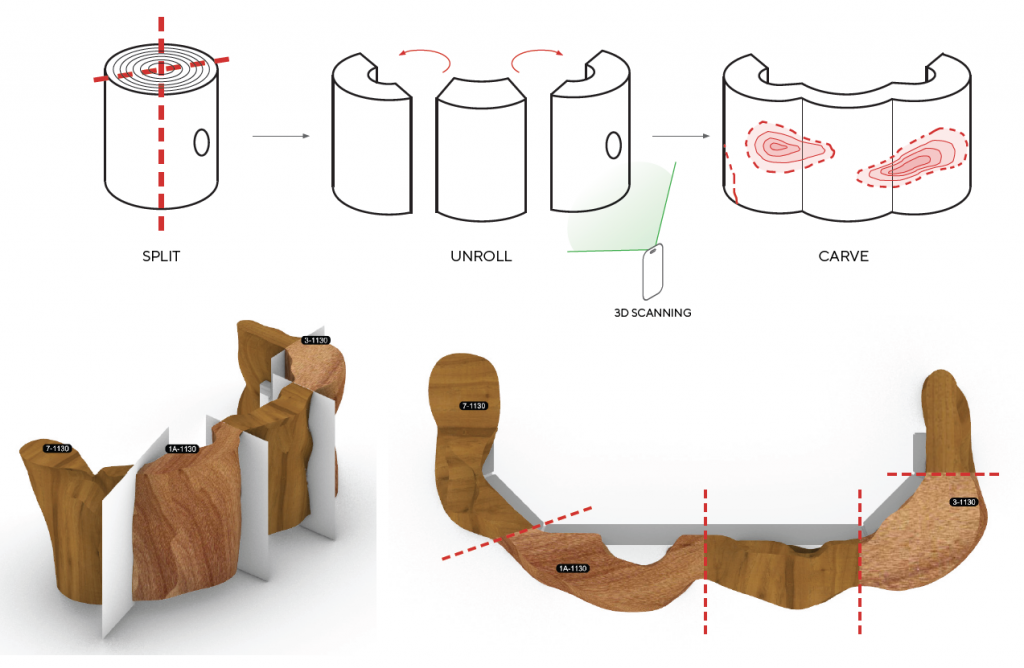
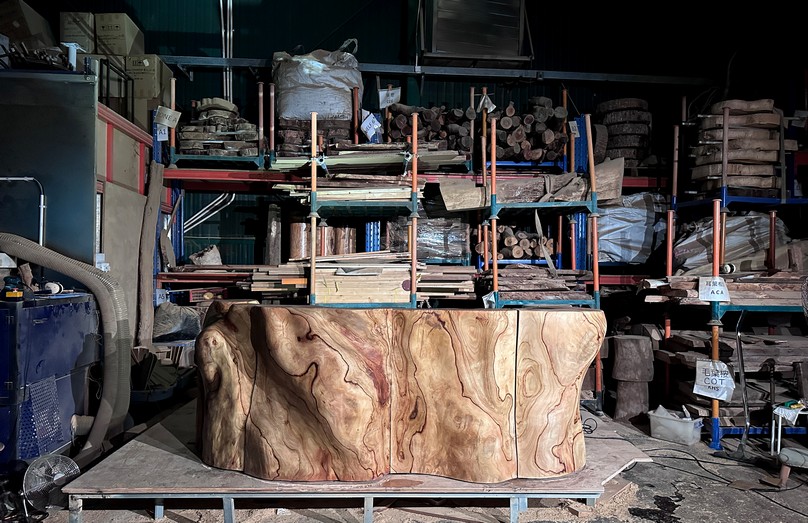
The concierge desk is truly an accent piece that speaks to sustainability and bringing nature indoors, and made the FRAME Awards 2024 shortlist for ‘Furniture of the Year’.
The Scents and the Soil also demonstrates a design concept for the space that leaned towards the organic, which came out prominently not just in the desk itself but in the use of the staircase to elegantly wrap around and over it. The final staircase design was inspired by human motion, specifically in Marcel Duchamp’s iconic Nude Descending a Staircase, No. 2, a work that falls between Cubist and Futurist.
As the titular figure in the painting seems to dance with the space, the piece is engaged in a dance with the spiral staircase that curves away adjacent and behind. In this context, the pendant designed by the team feels like the dancer’s necklace, providing a delicate counterpoint to the solidity of the two structures.
Reimagining Gala Place
A similar approach defines the Oval Partnership’s work on Hang Lung’s office at the top of Gala Place, which transforms the previously planned space with thoughtful functions and finishes. Here, the experience begins on entry, where an existing atrium that extends over the office’s three levels takes the eye upward and evokes a feeling of spaciousness and calm. The space’s permeability also makes it a perfect place for people to meet and congregate, a function made even more attractive by the design team. Here, the existing central pillar was a structural column that could not be removed, so the team chose to maximise it as a feature by building a cafe around it, then adding social spaces all around. The cafe counter is made of salvaged and partly finished wood obtained from the original rooftop water tower, topped with polished green granite for a raw-meets-finished aesthetic.
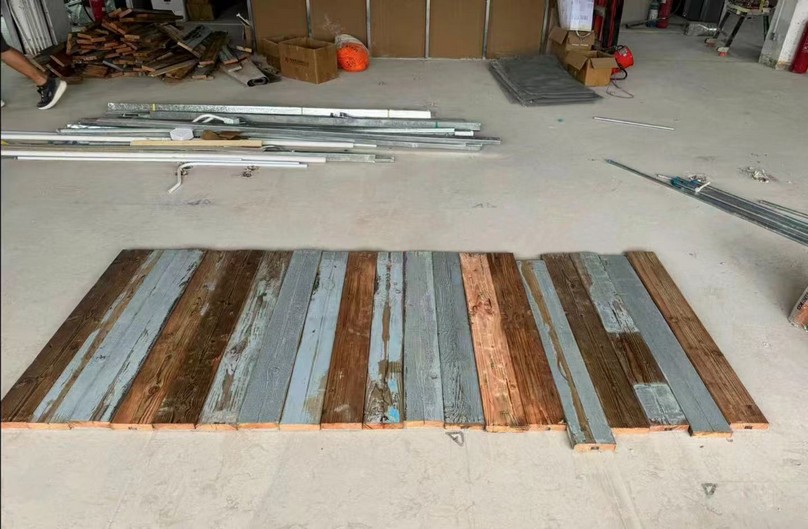
The space also provides a cue to the overall material palette: throughout, the design team integrated old and new, sharp and soft, warmly tactile and cool. Decades-old timber was salvaged and repurposed with minimal changes to its surface, preserving its history, with other materials including tactile fabrics and leather, as well as fabric-laminated glass and cool stainless steel. Overhead, a skylight floods the space with natural light, naturally improving moods and providing a variety of dappled shadow effects as the day passes, while greenery dots the space and brings nature in.
But while the approach is contemporary, craft features throughout. The reception desk is also made of salvaged timber with a process similar to that used for The Scents and the Soil. Furniture and fixtures are a combination of tailored designs that prioritise both functional use and aesthetic appeal, ensuring user comfort with appropriate dimensional considerations.
The meeting areas continue the hospitality-forward approach, with colourful palettes making for a stimulating environment. This includes the baffle overhead, which dampens sound in the large space as well as providing a visual anchor. Conference rooms are panelled with fluted wood that gives a quiet sense of structure and the comfort of a natural material.
The spaces are also practical, ranging from private to intimate to large, and from formal to casual. The team specified cutting-edge videoconferencing facilities, and carefully considered the hardware for office acoustics and lighting.
One marker meeting space is Social Hub, a semi-open amphitheatre-like area that invites all forms of collaboration from presentations to sharing sessions across its multiple tiers of seating. And if team members need time to recharge, they can head to one of the Wellness Rooms. These softly lit spaces feature relaxing tactile materials and comfortable furniture perfect for relaxation, plus enough space to do some calming yoga.
Offices are open, and an industrial-chic aesthetic predominates, with warm wood tones accented by forest green fabrics and deliberately exposed services. ‘We designed lighting typologies that integrate the services and show the industrial integration,’ says Lau of the approach. Thoughtful touches abound, even those that may register only subconsciously, like the series of pendant lights that come together to form a feature that shows articulation.
Overall, says Lau, the design ‘emphasises a natural and calming aesthetic’. Oval shapes and soft edges maintain consistency with the original window form and the original building facade, while taking the space into the future.
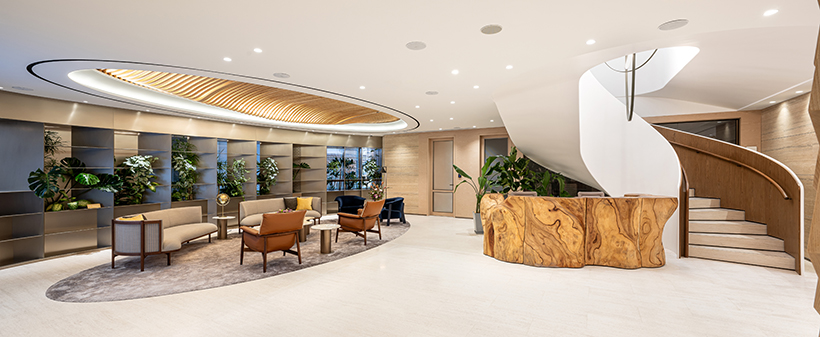
The reception space at the Standard Chartered Bank Building is at once welcoming and calming, with design details that reveal themselves on close inspection_Hang Lung Properties
Quotes from Project Director Justin Lau
- ‘There’s been an ongoing office evolution across generations. These are what we call third-generation offices.’
- ‘To start, we looked at Hang Lung’s culture. They increasingly collaborate across different disciplines, so the spaces all allow for that.’
- ‘We used some of the same principles as we do in our placemaking work. We looked at it from the bottom up, considering things like visual permeability and natural light. And storytelling is always a major element. In Hang Lung’s case, they wanted finesse and rejuvenation, so we looked at the plans in terms of a story that would resonate with them and their culture, that was aesthetically pleasing, and that would work in a very functional sense.’
- ‘We aimed to bring things together at these nodal points. We made opportunities for interactions.’