











Shenzhen Yulong Urban Design: Turning Former Landfill into Innovation Valley
KEY HIGHLIGHTS
- Reactivating Public Realm: transforming a major former landfill site in Shenzhen’s Luohu District into a new urban landmark for the district.
- Reserving the Unique Topology: shaping the space around the topology to create a distinctive terraced landscape.
- Creating a multi-level valley innovation: seamlessly combining work, living, public space and nature in a connected urban ecosystem.
- Building a resilient landscape: Blue, green and grey infrastructure are integrated to support water management, biodiversity and long-term climate adaptation.
PROJECT OVERVIEW
From Landfill to Landscape: Reimagining a City’s Future Through Design
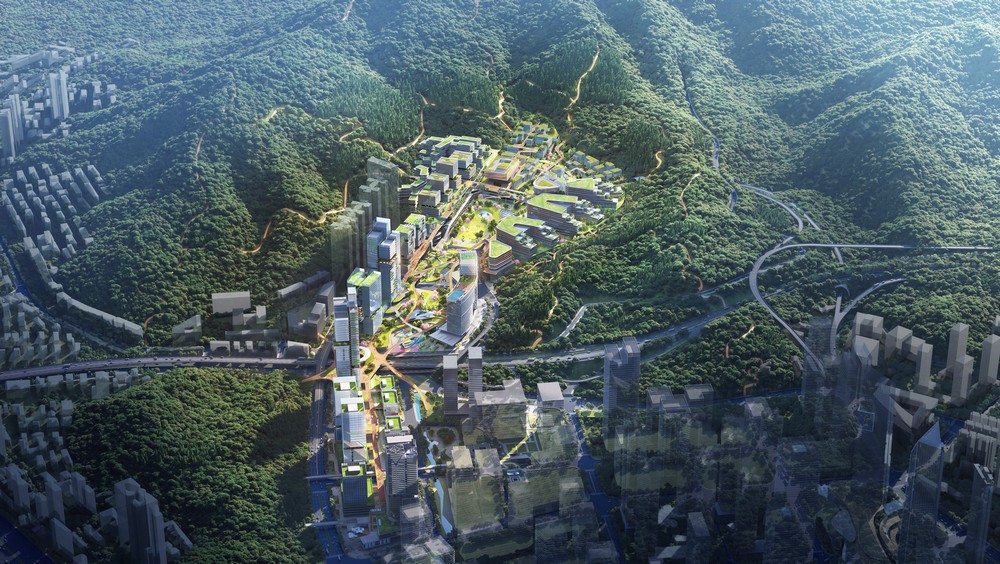
Nestled within the folds of Yinhu Mountain in Shenzhen’s Luohu District, one of China’s most ambitious urban regeneration projects is unfolding.
For decades, the Yulong site was known as the country’s largest landfill. Today, following an unprecedented environmental remediation programme involving the excavation and removal of legacy waste, the site is being given an entirely new future.
The completion of remediation works will create a deep pit of 40m within the site, creating a distinctive valley landscape. The redevelopment will redefine the relationship between city, terrain and ecology that embraces its complexity.
The masterplan transforms a former environmental scar into a new innovation valley, allowing architecture, landscape and infrastructure to evolve directly from the site’s unique topography. What was once a symbol of urban consumption becomes a catalyst for ecological recovery, technological innovation and sustainable urban growth.
DESIGN CONCEPT & APPROACH
Designing with the Land
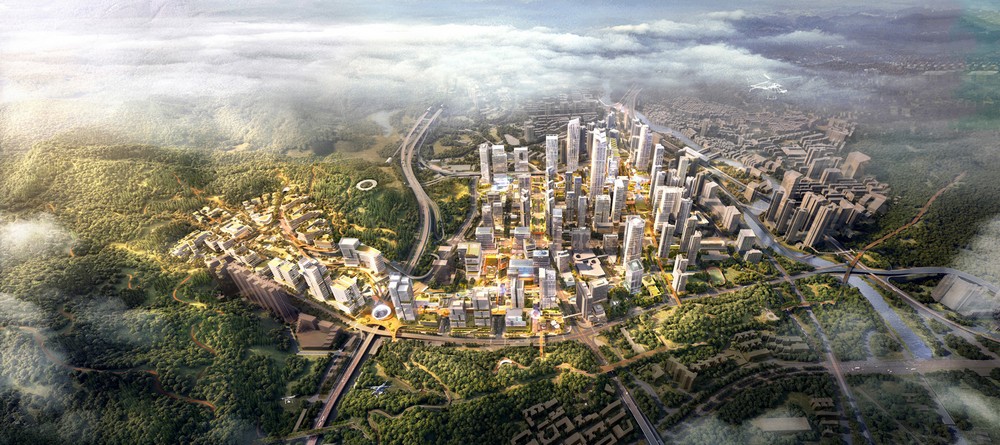
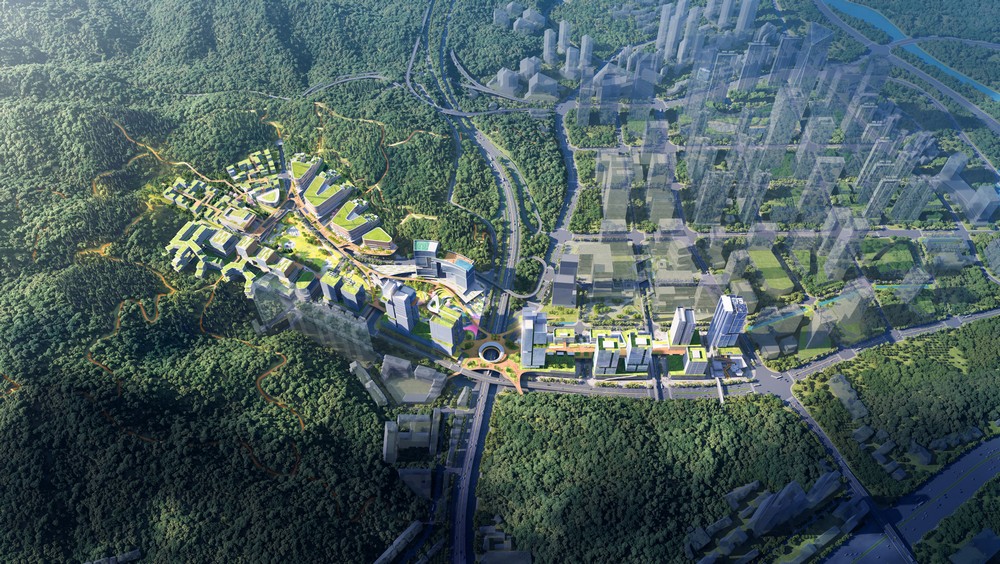
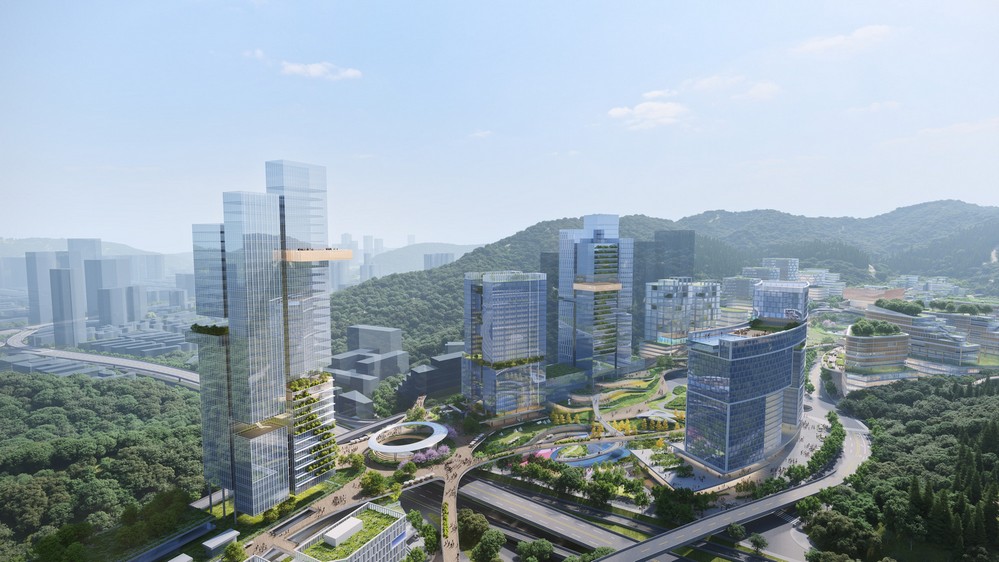
The 30-hectare site occupies a strategic location at the northern gateway of Luohu, framed by mountain ridges on three sides and positioned less than one kilometre from the future high-speed rail station. Yet its greatest defining characteristic is its terrain.
A 40m-deep pit coupled with the residual landform of the excavated landfill, presented a challenge few contemporary developments encounter. The design adopts a fundamentally different approach, allowing the landscape itself to become the organisational framework of the district.
The masterplan is guided by a strategy of selective intervention. Material generated through the rationalisation of higher ground is redistributed to soften transitions across lower areas, creating a more integrated and environmentally responsive terrain. The excavated valley provides spacious public area, accommodating innovation laboratories, pilot production facilities, servicing infrastructure and parking.
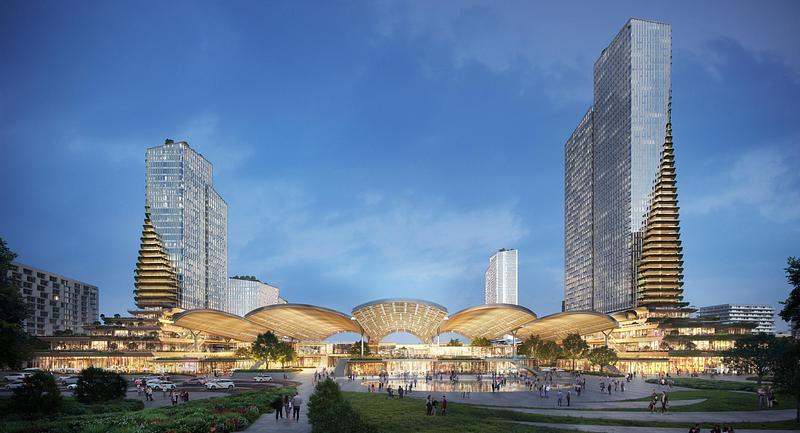
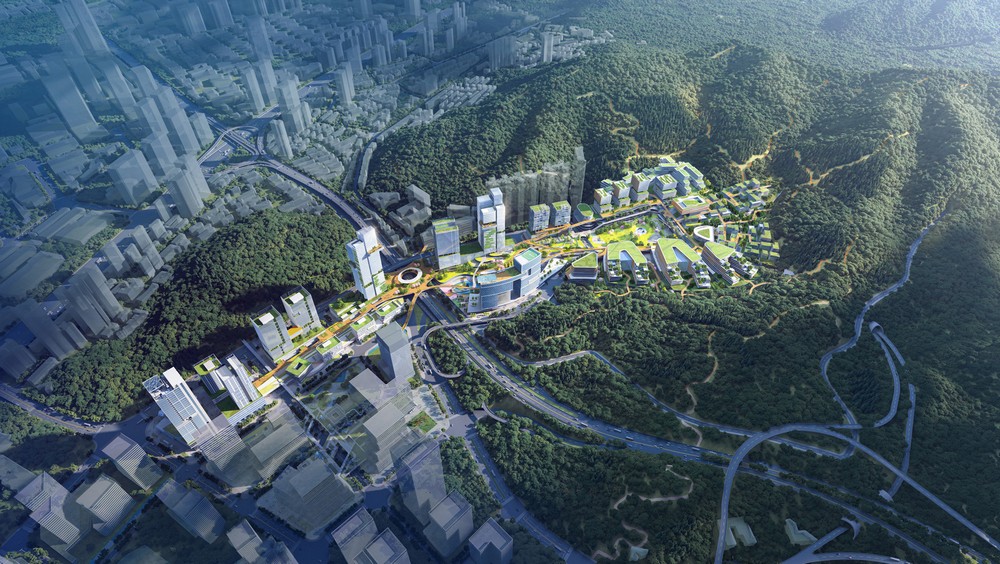
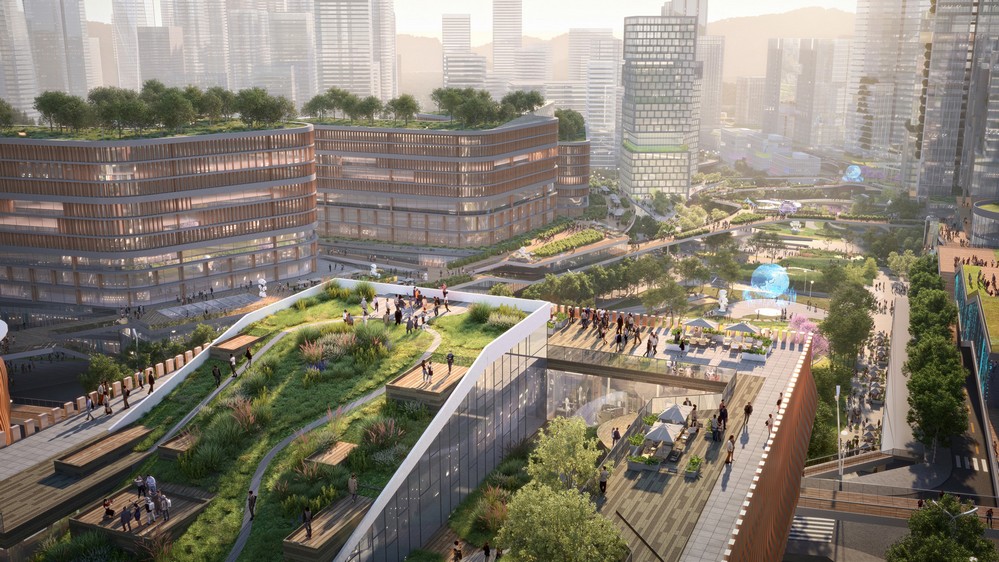
Through the integration of earthworks, underground development and construction phasing, the scheme substantially reduces excavation and fill requirements while establishing a more sustainable model of site development. It preserves the character of the valley rather than replacing it. Stepped terraces ascend the mountainside in a sequence of cascading forms that reinterpret the agricultural terraces historically found throughout southern China. Larger podium volumes anchor the development at the valley floor, while lighter upper levels progressively recede into the terrain. They create a built form that appears less constructed than cultivated, as though the architecture had grown naturally from the contours of Yinhu Mountain itself.
A Valley Campus in Three Dimensions
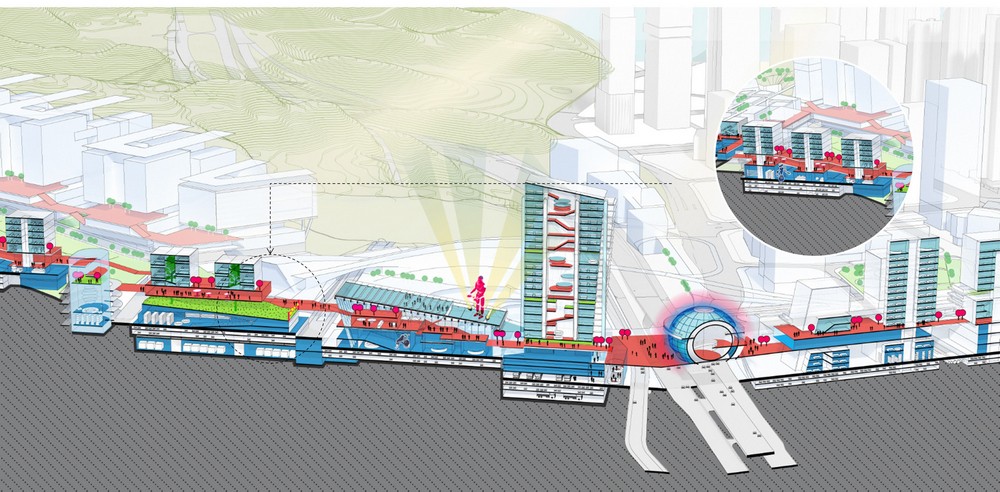
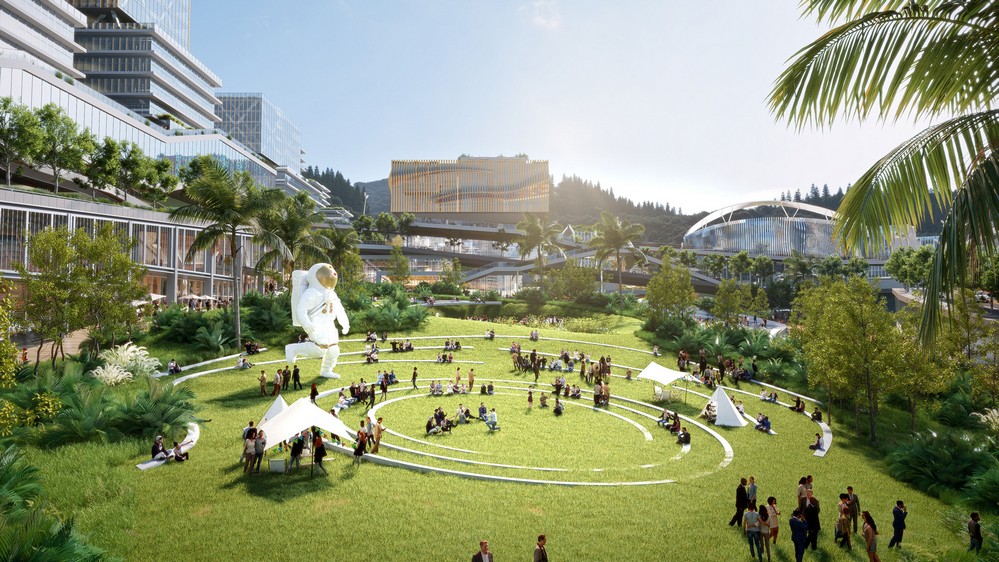
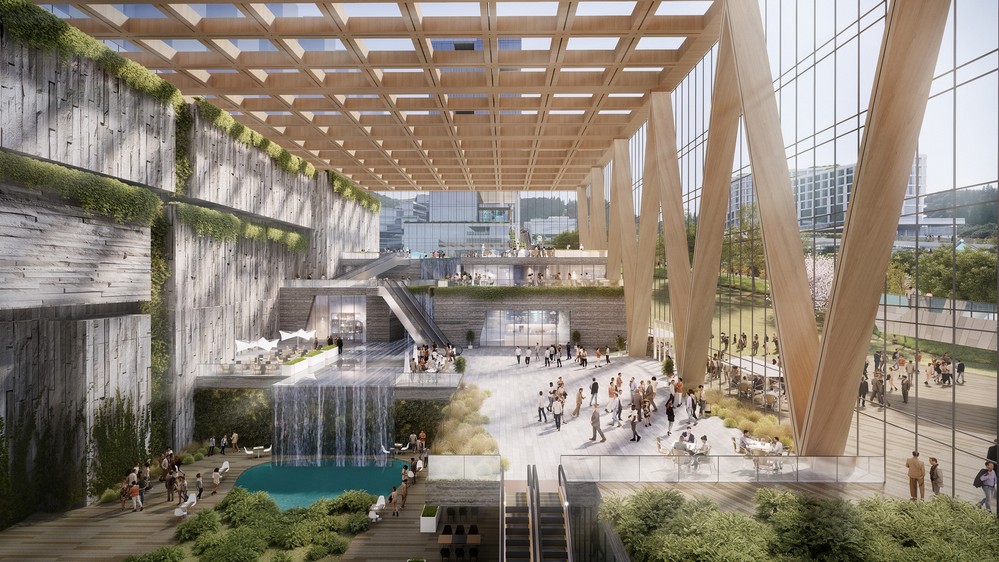
The Valley is conceived as a multi-layered urban landscape. A sequence of interconnected platforms at varying elevations establishes a three-dimensional public realm where movement unfolds both horizontally and vertically. Networks of landscaped stairways, panoramic walkways and strategically located mobility hubs connect the valley floor with upper terraces, transforming circulation into a continuous spatial experience.
The project creates a contemporary valley settlement where workspaces, public amenities, landscape and social life coexist within a richly layered environment.
At the centre of the composition is a continuous linear green corridor that acts as the ecological and social backbone of the masterplan. Threading through the site, it reconnects fragmented topographies while extending the landscape of Yinhu Mountain deep into the urban fabric.
Visitors arriving from the metro are gradually immersed within a sequence of elevated gardens, shaded plazas and civic landscapes. As they move upward through the valley, new perspectives emerge, revealing the interplay between architecture and terrain, while framing expansive views towards the mountain ridges beyond.
Seen from Yuping Avenue, the district presents a distinctive skyline that responds to its natural context. The design echoes their rhythm and silhouette, creating a composition defined by dialogue rather than dominance.
SUSTAINABILITY & INNOVATION
Resilience as Landscape
Resilience is embedded within the masterplan not as a layer of infrastructure, but as a defining design principle. The site’s mountainous setting presents significant hydrological challenges, particularly during Shenzhen’s increasingly intense storm events. The response is a comprehensive blue-green infrastructure network that works with natural systems rather than against them.
Flood interception channels establish a protective perimeter around the development, while a hierarchy of wetlands, bioswales, rain gardens and retention landscapes manage water throughout the site. Together, these elements form a living sponge system capable of slowing, absorbing, filtering and reusing stormwater before it ultimately reconnects with the wider watershed.
During the rainy season, the landscape functions as vital flood mitigation infrastructure. During drier periods, the same spaces become ecological habitats and civic parks.
The central green corridor, following the site’s natural contours, performs a dual role as both public space and environmental safeguard. In moments of extreme weather, it quietly absorbs the pressures of the surrounding catchment. In everyday life, it offers a continuous landscape experience that reconnects people with nature.
From Remediation to Regeneration
Yulong Innovation Valley represents more than the redevelopment of a former landfill. It demonstrates how cities can transform inherited environmental challenges into opportunities for long-term growth. By embracing topography, restoring ecological systems and creating a new framework for innovation-led development, the project establishes a model that extends far beyond Shenzhen.
Across China, hundreds of closed landfills are still waiting to be sealed or passively monitored. Yulong proposes a different future, one that moves beyond containment and remediation towards genuine regeneration. The project is ultimately a story of transformation: from burden to asset, from excavation to creation, from scar to landscape.
‘From a valley of restored land to a landscape platform for innovation, the evolution is slowly taking shape in the valley of Yinhu Mountain. The design aims to implement a better urban development for the people in the future, minimising the cost of its past development,’ Leon shares.