












Relocate or Not To Relocate
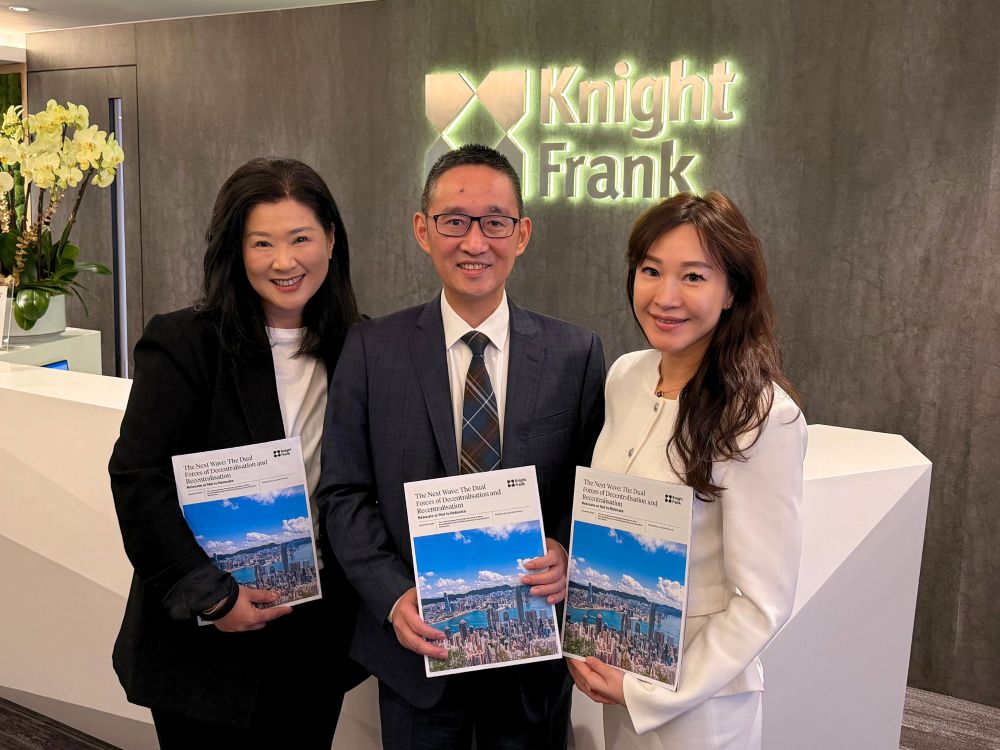
Knight Frank today released its latest Hong Kong Office Report, The Next Wave: The Dual Forces of De-centralisation and Re-centralisation Relocate or Not To Relocate, highlighting a renewed wave of office decentralisation as the sharp recovery in Central rents and tightening availability prompt occupiers to reassess their location strategies. Conversely, occupiers with strong stickiness to Central can relocate back by tapping into existing vacancies to lock in rents before they climb further.
Premium Central rents have rebounded 28.8% from their August 2025 trough to HK$130 per sq ft per month in September 2026, reversing three years of rental declines in just 13 months. Vacancy in Premium Central also fell from 14.5% at the beginning of 2026 to 6.9% in September, reflecting stronger demand for prime office space. The flagship assets, such as One and Two IFC, are operating at close to full occupancy; the supply squeeze is driving decentralisation again.
Against this backdrop, the widening rental gap is strengthening the case for decentralisation, with occupiers potentially achieving rental savings of HK$35–66 per sq ft by relocating from Central to West Kowloon, Causeway Bay or Quarry Bay.
At the same time, the completion of International Gateway Centre and Artist Square Towers has expanded West Kowloon’s Grade A office stock to more than 4.2 million sq ft, creating greater capacity to accommodate large corporate occupiers.
Knight Frank’s analysis of office relocations between 2024 and the third quarter of 2026 shows that more than 896,126 sq ft of committed net floor area relocated out of the core CBD (Central, Admiralty and Sheung Wan). West Kowloon was the leading destination, capturing 78% of the total, equivalent to approximately 700,859 sq ft, across seven major transactions.
Further analysis of the relocation data reveals three distinct migration patterns across the core CBD districts:
1. Central: West Kowloon emerges as the dominant destination (90% Captured)
- West Kowloon accounted for 90% of the committed net floor area relocated out of Central, equivalent to more than 530,857 sq ft across five major transactions. The trend indicates that occupiers are not simply moving to lower-cost fringe locations. Instead, they are seeking institutional-grade buildings offering large contiguous floorplates, premium specifications and convenient High-Speed Rail connectivity.
2. Sheung Wan: Relocations split across the harbour and core districts (43% to West Kowloon)
- Sheung Wan recorded 357,099 sq ft of outbound relocations, with West Kowloon emerging as the top destination, accounting for 43%, equivalent to 154,411 sq ft of the total. Central attracted a further 18% of the market, as some occupiers took advantage of the market trough to upgrade to core locations, while others moved to more cost-effective districts, including Wan Chai and Wong Chuk Hang.
3. Admiralty: Hyper-Local Clustered Upgrades (Wan Chai & Central Dominate)
- Admiralty occupiers showed a strong preference for staying within the core business corridor, with Central and Wan Chai accounting for 38% and 32% of relocations, respectively, while West Kowloon accounted for 16%. This reflects occupiers’ continued preference for maintaining proximity to key government and institutional hubs.
Wendy Lau, Executive Director, Head of Hong Kong Office Strategy & Solutions, said.
“Central’s strong recovery reflects a clear flight to quality, particularly among financial and investment firms. As availability tightens and rents rise, occupiers are becoming more strategic about their location decisions. This is not simply a shift away from Central, but a more segmented market, with Central and West Kowloon serving different occupier needs.”
Steve Ng, Executive Director, Head of Kowloon Office Strategy & Solutions, said,
“We are seeing growing interest in West Kowloon from occupiers looking for high-quality office space, larger floorplates and greater cost efficiency. Its strong connectivity and expanding cluster of financial institutions are also strengthening its position as a major office hub. As more major occupiers establish a presence, we expect this momentum to continue, particularly among companies with larger space requirements.”
Esther Liu, Director and Head of Research & Consultancy, Greater China, said,
“Dual forces of decentralisation and recentralisation are underway. West Kowloon is the top choice for companies relocating from Central, Admiralty, and Sheung Wan. These locations accounted for 78% of relocations from 2024 to 2026 YTD. We believe the primary beneficiaries of this decentralisation trend are West Kowloon and Causeway Bay, due to their large new supply and expansive floorplates. Recentralisation is the opposing trend, driven by occupiers who prefer traditional core locations and want to lock in rents before they rally further.”