












At a press conference held in Knight Frank Hong Kong office this afternoon, Wendy Lau, Executive Director, Head of Hong Kong Office Strategy & Solutions, Steve Ng, Executive Director, Head of Kowloon Office Strategy & Solutions, Antonio Wu, Head of Capital Markets, Greater China, Martin Wong, Senior Director, Head of Research & Consultancy, Greater China, Helen Mak, Senior Director and Head of Retail Services and William Lau, Senior Director, Head of Residential Agency presented their forecasts for Hong Kong’s property market for 2026.
Hong Kong Property Market 2026 Forecast:
Hong Kong Residential Market:
Martin Wong, Senior Director and Head of Research & Consultancy, Greater China
Hong Kong’s residential market is showing signs of recovery, though unsold inventory remains a key challenge. Developers are actively clearing stock and are expected to introduce more incentives and flexible financing schemes to attract buyers. Around 12,000–13,000 units still need to be absorbed before a strong price rebound can materialise.
Residential transaction activity is stabilising, with monthly volumes currently at about 5,000 units. Well-located and competitively priced projects continue to receive strong market responses with high sell-through rates. Looking ahead, we expect the overall transaction volume to increase to 65,000-68,000 units in 2026.
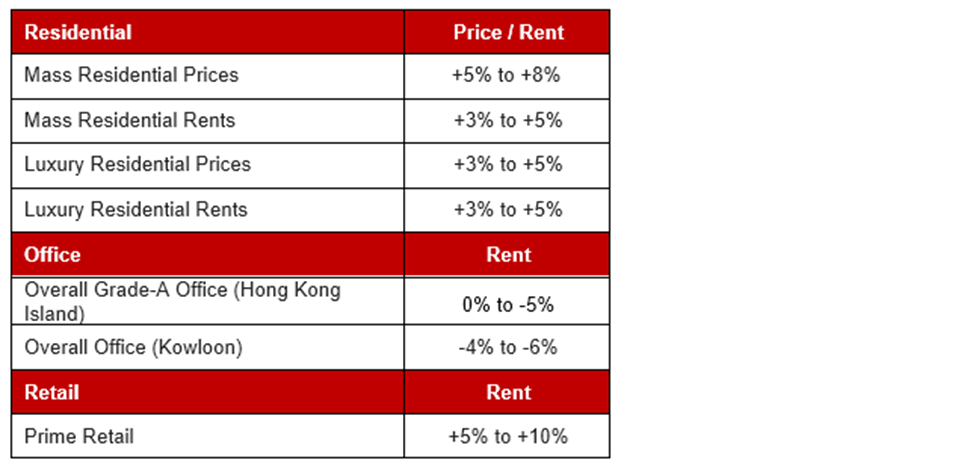
Favourable financing conditions are supporting sentiment. A further interest rate cut is expected, which will likely push mortgage rates below 3% and ease borrowing costs. This improved affordability is expected to gradually lift home prices, with mass residential prices forecast to increase by 5% to 8% in 2026. Rental demand, driven by talent inflows and non-local students, is also set to strengthen, with rents projected to increase by 3–5%, potentially reaching record highs.
For 2026, land sale revenue is forecast to reach between HK$12 billion and HK$15 billion, representing a 60% year-on-year increase. Meanwhile, land premiums paid for private development are expected to rebound to between HK$8 billion and HK$10 billion.
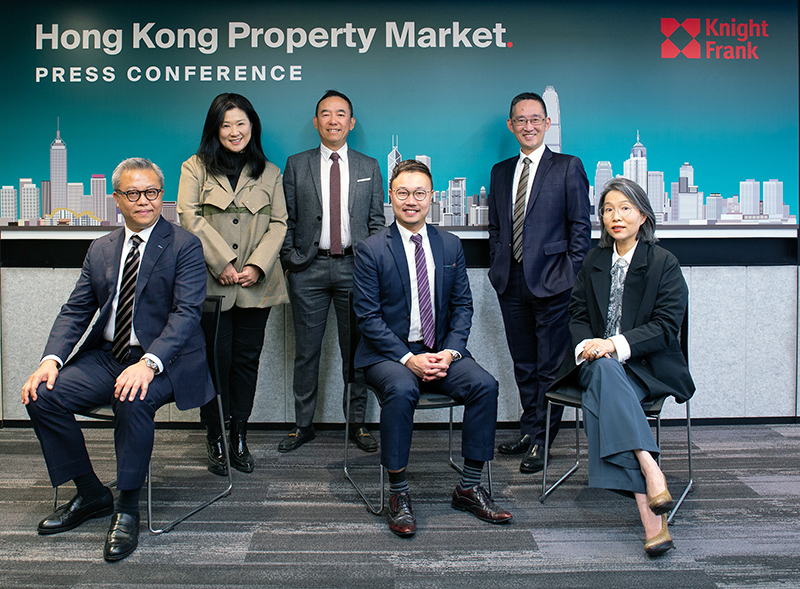
From left to right – William Lau, Senior Director, Head of Residential Agency, Wendy Lau, Executive Director, Head of Hong Kong Office Strategy & Solutions, Antonio Wu, Head of Capital Markets, Greater China, Martin Wong, Senior Director, Head of Research & Consultancy, Greater China, Steve Ng, Executive Director, Head of Kowloon Office Strategy & Solutions and Helen Mak, Senior Director and Head of Retail Services at Knight Frank.
William Lau, Senior Director, Head of Residential Agency
Hong Kong’s luxury property market has seen a noticeable rebound, with a rising number of transactions in recent months. In the super-luxury segment (properties priced above HK$78 million), the final quarter of last year saw 80 deals—the highest quarterly figure since Q4 2021. Activity has continued strongly into the new year: in the HK$50 million-plus category, seven transactions were recorded in the first week of January alone, following 46 deals in December.
Hong Kong’s luxury residential market is expected to strengthen further in 2026. Improved sentiment and sustained interest from cash-rich buyers will underpin price growth, while the limited supply of luxury homes continues to support values. The recovery will be driven by renewed interest from the Chinese mainland and overseas buyers, alongside a gradual improvement in global economic conditions. Sales activity is expected to pick up further, and the luxury home prices are expected to grow by 5%.
The leasing market is set to maintain its upward trajectory. Demand will remain robust, driven by professionals and families from the Chinese Mainland, as well as local professionals and the return of expatriates from the finance and corporate sectors. Prime neighbourhoods such as Kai Tak and West Kowloon are particularly favoured by the Chinese mainland tenants. We expect luxury rents to increase by 3% to 5% in 2026.
Hong Kong Island Office Market:
Wendy Lau, Executive Director and Head of Hong Kong Office Strategy & Solutions
The Grade-A office leasing market on Hong Kong Island remains subdued, with a slight improvement in demand. Rents continue to decrease further, and vacancy rates remain high. This situation reflects ongoing concerns regarding economic uncertainty, leading occupiers to adopt a cautious approach in their leasing decisions.
Premium buildings in Central are showing signs of improvement, with rental growth returning to positive territory, while traditional Central buildings remain under pressure. Some areas underperformed, such as Causeway Bay and Quarry Bay. Leasing demand is led by the finance sector and PRC enterprises. Moreover, future supply in Hong Kong Island will continue to be a significant concern for both the rental trajectory and occupancy.
As we approach 2026, the office market on Hong Kong Island is set to face both opportunities and challenges. Larger occupiers are poised to expand, capitalising on flight-to-quality trends and the rare availability of large, distinctive floorplates, while companies from the PRC continue to generate robust demand. Occupiers are increasingly preferring more flexibility in lease terms and placing emphasis on in-house amenities and functional spaces.
Our full-year rental forecast for Grade-A offices on Hong Kong Island is projected to decline by 0% to 5%, while premium Central is expected to record positive growth up to 8% in 2026.
Kowloon Office Market:
Steve Ng, Executive Director and Head of Kowloon Office Strategy & Solutions
Kowloon’s office market remains under pressure, though signs of a “soft landing” are beginning to emerge. Vacancy rates are easing in Kowloon Central and Kowloon West, primarily supported by targeted demand from banking, finance, and insurance tenants pursuing expansion opportunities in the Greater Bay Area. These tenants are prioritising Grade-A buildings with premium harbour views, which provides limited but crucial support in cushioning the downward rent trend — explaining the appearance of a soft landing. However, Kowloon East continues to face a persistent supply surplus, contributing to overall market polarisation: harbour-view Grade-A offices are drawing steady interest from these sectors, while Kowloon East endures ongoing downward pressure. Despite these positive signals, the absence of large-scale occupiers continues to weigh on performance.
The trajectory of this soft landing — whether it can “land safely” — hinges on key macro factors, including government policy direction, geopolitical tensions, and investment-driven supply.
Looking ahead, a sharp reduction in new major supply from 2026 onward will provide the market with essential time to absorb the substantial leftover stock from 2024 and 2025. This dynamic should enable a gradual shift away from declining trends, with the market likely to bottom out in the second half of 2026, contingent on favourable macro conditions. Overall, Kowloon office rents are projected to decline by 4-6% in 2026, indicating that while challenges persist, the market is steadily progressing toward recovery.
Hong Kong Capital Markets:
Antonio Wu, Head of Capital Markets, Greater China
In 2025, properties valued at HK$100 million or more saw a total transaction volume of HK$60.3 billion (151 transactions), up 45% year-on-year. Of these, 106 transactions took place between June and December, marking a surge of over 77% compared to the same period last year.
The office sector led the market, accounting for 48% of total activity, driven by rising end‑user demand supported by stabilised prices and revived Chinese IPO activity. Residential Investment followed at 26%, driven by strong end‑user and investor demand, heightened developer appetite for private development sites, and an uptick in site sales. Hotels and serviced apartments accounted for 10%, with supply still falling short of overall demand and the ongoing purpose-built student accommodation (PBSA) gap remaining a key focus for institutional investors. Retail transactions lagged at 5% amid weak consumer confidence and structural shifts in spending habits.
Looking ahead to 2026, Hong Kong’s capital markets are expected to gain momentum across major sectors. The PBSA sector is expected to continue attracting local and foreign investors, with hotel transactions staying active. Office transactions are set to rise, driven by end-user demand and growing investor interest. Chinese mainland buyers are expected to continue driving the super‑luxury segment, with home prices likely to trend upward in the second half of 2026. Meanwhile, receivership sales will continue to be a significant driver in the sales market.
Hong Kong Retail Market:
Helen Mak, Senior Director, Head of Retail Services
Hong Kong’s retail market is undergoing a structural shift, driven by e‑commerce growth and cross-border spending patterns. From 2021 to 2024, local online sales consistently exceeded HK$30 billion annually, a sharp increase from HK$20.6 billion in 2020. By the end of 2025, online sales are projected to reach HK$35 billion, highlighting the growing dominance of e‑commerce in consumer behaviour.
Credit card spending patterns further illustrate this transformation. Credit card transactions surged from HK$591 billion in 2020 to HK$1,023 billion in 2024, with HK$801 billion recorded in the first three quarters of 2025. Overseas spending accounted for 34.1% in the first three quarters of 2025, meaning more than one‑third of card spending is now taking place abroad, a reflection of the rebound in travel and growing comfort with online shopping.
Local retail sales in 2024 lagged behind 2023, but when factoring in increasing overseas spending and northbound spending, domestic demand remains relatively resilient. Looking ahead, Knight Frank forecasts a bifurcation in rental performance by 2026: Prime street shop rents are projected to rise 5–10%, fuelled by recovering luxury sales and new brands’ preference for high-visibility locations. Conversely, neighbourhood centre rents may fall by up to 5%, impacted by e-commerce growth and increased northbound spending, which affects community tenants more severely.