














As building energy performance becomes transparent to the public, energy-efficiency upgrades and optimisation could help strengthen leasing competitiveness.
Key Takeaways:
- The Buildings Energy Efficiency (Amendment) Ordinance 2025 introduces greater transparency in building energy performance. With energy audit data open to public scrutiny, energy efficiency will play a growing role in leasing competitiveness and asset value.
- To help building owners prepare early, JLL brings together 10 sustainability consultants and engineering specialists to further strengthen its energy and sustainability advisory services.
- Early planning and the establishment of robust energy management systems will help address regulatory requirements while enhancing operational efficiency, asset performance and long-term competitiveness.
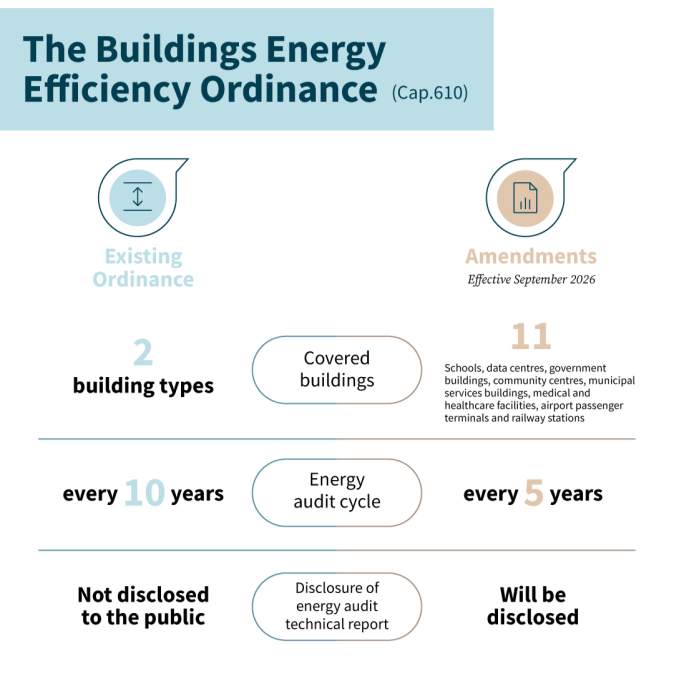
With the Buildings Energy Efficiency (Amendment) Ordinance 2025 set to be fully implemented on 20 September 2026, Hong Kong’s property market is set to face an unprecedented test of transparency. The new amendments will expand the scope of regulated buildings from two categories to 11, including commercial buildings and data centres, shorten the energy audit cycle from 10 years to five and mandate the disclosure of technical data in energy audit reports. To help building owners prepare early, JLL today announced that its Project & Development Services (PDS) team, bringing together 10 sustainability consultants and engineering specialists to further strengthen its energy and sustainability advisory services. The team will provide a one-stop service covering energy audits, regulatory compliance, sustainability planning and energy-efficiency optimisation.
Previously, only commercial and composite buildings were required to undergo regular energy audits. Under the revised ordinance, the scope of regulated buildings will be expanded to data centres, school, government buildings, community buildings, municipal services buildings, buildings for medical and health care services, airport passenger terminal buildings and railway stations.
Ryan Wong, Head of Project & Development Services, at JLL in Hong Kong, said:
“The most far-reaching impact of the amendment lies in the significant improvement in the visibility of properties’ environmental performance among the public and prospective tenants, which is expected to further intensify market competition. Recently, we have received enquiries from a number of building owners in core districts such as Central and Lan Kwai Fong, who are concerned that ageing building facilities may weaken their properties’ competitiveness once mandatory data disclosure takes effect. Even if a commercial building appears well maintained externally, disclosed data may reveal ageing internal facilities and poor energy efficiency. Tenants and investors will factor in potential equipment failure risks and higher electricity costs, and compare these directly with other commercial buildings, which will undoubtedly affect leasing or acquisition decisions.”
JLL noted that in an increasingly stringent regulatory environment, owners and asset managers of regulated property categories will need to not only conduct energy audits in accordance with statutory requirements and establish robust energy data management systems to support periodic reviews, but also plan ahead for equipment upgrades and capital investment. Through strategic upgrades of ageing facilities and investment in building sustainability, owners can improve their properties’ energy performance data and maintain market competitiveness.
To address the challenges arising from the amendment, JLL’s sustainability dedicated team will provide one-stop, tailor-made services, developing the most cost-effective solutions for owners based on property holding period, payback period and capital returns. At the sustainable development strategy advisory level, the team will assist clients with energy audits to comply with ordinance requirements, developing ESG roadmaps, conducting climate risk assessments, and planning practical pathways to net-zero carbon emissions. In the area of green building certification, the team provides retro-commissioning services as well as technical support for certification programmes such as BEAM Plus, LEED and WELL. In addition, for sustainable fit-out and workplace design, the team will help building owners enhance operational performance and resource efficiency through measures such as the use of low-carbon building materials, circular procurement practices and improvements to indoor environmental quality.

JLL recommends that building owners should not view measures to address the new requirements as a passive “compliance cost”, but rather as a strategic opportunity to enhance asset returns. JLL data shows that targeted green building investment can not only defend against asset depreciation but also generate significant financial returns. For example, properties with strong energy efficiency can meet tenants’ rising sustainability expectations, effectively attracting and retaining quality tenants and potentially creating green rental premiums of up to 10%. Such investment can also help owners achieve net-zero carbon targets and reduce embodied carbon emissions by up to 40%. In addition, optimisation measures can safeguard asset liquidity while significantly reducing operating expenses such as utilities by up to 50%, with the potential to drive an overall asset value uplift of 15% over the long term.
Ryan added: “The amendments mark an important milestone in Hong Kong’s efforts to enhance energy efficiency and reduce carbon emissions in the built environment. As the city advances towards its 2050 carbon neutrality target, market expectations for green buildings and building energy management will continue to rise. For building owners and asset managers, the new requirements are not only a matter of regulatory compliance, but also reflect the growing market focus on property energy performance. Early planning and the establishment of robust energy management systems will help address regulatory requirements while enhancing operational efficiency, asset performance and long-term competitiveness.”
To support the market’s smooth transition, JLL’s dedicated team is now offering a free initial gap analysis service to help building owners quickly determine whether their assets fall within the 11 categories of regulated buildings, clarify specific statutory energy audit deadlines based on the occupation permit, and formulate an immediate follow-up action list to achieve compliance. This will help owners turn regulatory challenges into an opportunity to enhance the long-term commercial value of their properties.