












HONG KONG, 6 July 2026 – Central’s Grade A office market recorded its strongest half-year rental growth in 15 years in 1H 2026, supported by leasing momentum that began building late last year, according to JLL’s 2026 Mid-Year Market Review and Forecast released today. JLL now expects Central’s Grade A office rents to rise by 10-15% in 2026, while overall Grade A office rents are forecast to increase by 0-5%.
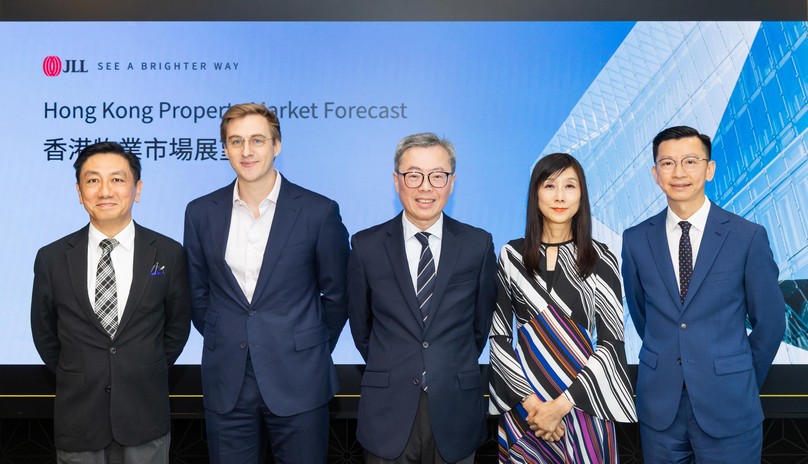
(Left to right) Danny Chan, Executive Director; Sam Gourlay, Head of Office Leasing Advisory at JLL in Hong Kong; Joseph Tsang, Chairman of JLL in Hong Kong; Jeannette Chan, Senior Director of Retail at JLL; Alkan Au, Head of value and risk advisory
Cathie Chung, Senior Director of Research at JLL, said: “Selected districts are beginning to benefit from spillover demand from Central. The office investment market has also been supported by improving leasing conditions, with Grade A office prices recording a mild rebound. Although tenants in the retail market continue to face a challenging business environment, the decline in retail rents has moderated. The housing market remains the main driver of the property market recovery, while the recently announced overseas investment regulations in Mainland China will be a key variable for market momentum over the next six months.”
Key points:
- Benchmark buildings such as One ifc and Two ifc recorded rental increases of 23.4% and 20.2%, respectively, both exceeding HKD 130 per sq ft.
- Vacancy in Central fell to 8.8% at the end of June, the lowest level in 43 months.
- Vacancy in Prime shopping malls rose to a record high of 13.7% at the end of June, but vacancy in High Street shops improved to 9.1%, the lowest level since 2020.
- New non-local retail brands openings increased by 38.8% in 1H 2026 compared with 2H 2025.
- End-users remain a key source of investment demand, particularly in the office sector, where they accounted for around 56% of total investment volume.
- We expect Grade A office capital values to stabilise this year, while High Street shop values are forecast to decline by 0-5%.
- The time required to absorb unsold residential flats has fallen from the last peak of 101.6 months to 44.3 months as at Mar-2026, below the 2015-2021 bull-market average of 51.3 months.
- JLL expects mass residential prices to increase by 5-10% this year, with most of the gains already realised in the first half of the year.
Office Market
Central is leading the recovery of Hong Kong’s Grade A office market, with rents rising 7.3% in 1H 2026 as growth accelerated significantly. Rents of Central Grade A1 offices have returned to the Q3 2023 level, while benchmark buildings such as One ifc and Two ifc recorded rental increases of 23.4% and 20.2%, respectively, exceeding HKD 130 per sq ft. This helped drive overall Grade A office rents up 3.2% in 1H 2026, marking the first meaningful half-year increase since the market correction began in mid-2019.
However, the recovery was concentrated in Central’s Grade A1 buildings, where rents rose 13.4% year to date. Central’s Grade A2 offices saw only moderate improvement, up 5.6% year to date, while Grade A3 rents are stabilising, edging up 1.4%.
Vacancy in Central fell to 8.8% at the end of June, the lowest level in 43 months. Vacancy rates in Wanchai/Causeway Bay and Tsimshatsui have largely stabilised, while vacancies in Kowloon East and Hong Kong East continued to rise.
The office market recovery is being driven primarily by a strong IPO pipeline and wealth inflows from mainland China. IPO activity is generating demand from issuers, sponsors, law firms and compliance teams, while wealth inflows are supporting the expansion of private banks, family offices and asset managers. Both trends are boosting demand for Grade A office space in core business districts. Expansion activity is currently concentrated among investment funds, insurance firms, legal services providers and fintech companies, with most demand focused on the CBD.
Sam Gourlay, Head of Office Leasing Advisory at JLL in Hong Kong, said: “We have revised our forecast for Central Grade A office rents, reflecting stronger leasing demand from financial institutions and related companies. Supported by IPO-related activity, wealth inflows from mainland China and the widely anticipated carried interest exemption, we expect Central Grade A office rents to rise by 10-15% in 2026. Rents in other core submarkets are expected to grow by 0-5%, while those in Hong Kong East and Kowloon East to drop 0-5%.”
He added: “Wanchai/Causeway Bay and Tsimshatsui are well positioned to benefit when tenants are priced out of Central. Tsimshatsui currently has the lowest vacancy rate among the major submarkets. If Central Grade A1 office rents rise above HKD 140 per sq ft, the resulting spillover demand could broaden the recovery more notably beyond a single district. While overall vacancy has improved to 13.1% as of mid-2026, further declines are likely to be constrained by incoming supply.”
Hong Kong Grade A Office Indicator – % Change
| Submarket | Rent (1H 2026) | 2026 Full Year Rental Forecast |
| Central | ▲7.3% | ▲10-15% |
| Wanchai/Causeway Bay | ▲1.7% | ▲0-5% |
| Tsimshatsui | ▲0.1% | ▲0-5% |
| Hong Kong East | ▼0.8% | ▼0-5% |
| Kowloon East | ▼3.6% | ▼0-5% |
| Overall | ▲3.2% | ▲0-5% |
Source: JLL Research
The retail market has shown signs of stabilisation over the past six months on the back of stabilising local consumption and the further improvement in inbound visitor arrivals.
This improving sentiment has encouraged some retailers to secure prime locations at attractive rental levels. The banking and securities, education, and fitness sectors expanded significantly in 1H 2026, taking up larger floor plates than other occupiers. Central and Tsimshatsui attracted the strongest leasing demand.
Vacancy in prime shopping malls rose to a record high of 13.7% at the end of June, driven by the underperformance of several prime malls. However, vacancy in High Street shops improved from 10.0% in end-2025 to 9.1%, the lowest level since 2020.
Retail rental declines moderated in 1H 2026. High Street shop rents fell 2.0%, compared with a 4.2% decline in 2H 2025. Meanwhile, despite a moderation in the increase in Prime shopping centre vacancy, the persistently high vacancy rate continued to put pressure on landlords, resulting in a 2.7% decline in rents.
Jeannette Chan, Senior Director of Retail at JLL in Hong Kong, said: “We are seeing a growing diversity of mainland Chinese brands entering Hong Kong’s retail market. F&B accounted for 35.7% of total new mainland Chinese entrants in 1H 2026, compared with 63.6% in 2H 2025. The mix of entrants has broadened across sectors, including cosmetics, lifestyle and electrical products. We expect further expansion by mainland Chinese brands into sectors such as cinemas, jewellery and gold, financial services and high-end dining.”
Given rentals have corrected for over 70% from last peak for High Street shops and over 45% for prime shopping centres, overall non-local brands also continued to expand in Hong Kong. New non-local openings increased by 38.8% in 1H 2026 compared with 2H 2025, with Japanese brands accounting for the largest share.
“Looking ahead, we expect High Street shop rental declines to continue moderating to 0-5% this year, supported by improving vacancy levels across the four core districts and the gradual stabilisation of retail sales. Prime shopping centre rents are also expected to decline 0-5% this year,” Chan added.
Hong Kong Prime Retail Indicator – % Change
| Sector | Rent (1H 2026) | 2026 Full Year Rental Forecast |
| High Street shops | ▼2.0% | ▼0-5% |
| Prime shopping centres | ▼2.7% | ▼0-5% |
Source: JLL Research
Capital Markets
Total investment volume for commercial properties valued at HKD 50 million or above fell by 48.1% to HKD 14.3 billion in 1H 2026, compared with the high level recorded in 2H 2025. Hotels and serviced apartments were the only commercial asset class to post growth, with transaction volume rising 20.5% over the period. Investment activity in the office, retail and industrial sectors declined amid uncertainty surrounding the interest rate outlook.
End-users remain a key source of demand, particularly in the office sector, where they accounted for around 56% of total investment volume. In the retail sector, demand came from a diverse range of occupiers, including education providers, securities firms, elderly care operators and F&B businesses.
Office capital values in Central and Wan Chai/Causeway Bay edged higher, supported by stronger leasing momentum in both districts. As a result, overall office capital values rose 0.4% over the past six months, marking the sector’s first increase since 2021.
The decline in High Street shop capital values moderated to 3.1% in 1H 2026, following a sharp correction of 17.1% in 2025. While educational institutions remained active buyers, investors also showed interest in retail assets backed by long-term leases and quality tenants.
Danny Chan, Executive Director of Capital Markets at JLL in Hong Kong, said: “Despite improving market sentiment, banks remain cautious about financing commercial assets, while uncertainty over the interest rate outlook continues to weigh on investment appetite. We expect Grade A office capital values to stabilise this year, while High Street shop and Prime Warehouse values are forecast to decline by 0-5% and 5-10%, respectively,”
“In the second half of 2026, investor interest will likely focus on residential sites, supported by the stronger performance of the housing market and greater availability of bank financing for residential projects. Mainland Chinese investors continue to target Grade A office assets valued at more than HKD 100 million. Hotel stock to sale is expected to tighten, particularly for assets priced between HKD 300 million to HKD 500 million, driven by demand for student accommodation and the ongoing recovery in tourism. Grade B and Grade C office buildings are emerging as alternative investment opportunities under the government’s Hostels in the City Scheme,” he added.
Hong Kong Investment Indicator – % Change
| Sector | Capital Values (1H 2026) | 2026 Full Year Capital Values Forecast |
| Grade A Offices | ▲0.4% | Flat |
| High Street Shops | ▼3.1% | ▼0-5% |
| Prime Warehouses | ▼3.5% | ▼5-10% |
Source: JLL Research
Residential Market
The residential market continued to recover, with total home sales rising 44.2% year on year in the first five months of 2026, while overall home prices increased 7.4%. Housing prices have rebounded 13.0% from their trough in March 2025.
Strong sales activity has significantly reduced inventory levels. At current sales rates, the time required to absorb unsold inventory has fallen from 101.6 months as at Dec-2023 to 44.3 months as at Mar-2026, below the 2015-2021 bull-market average of 51.3 months. As a result, the inventory overhang has eased and is no longer a major constraint on developers launching new projects.
The housing market has been supported by rising rents, robust demand from mainland Chinese buyers, limited housing supply and improving economic conditions. However, several risks remain, including the potential for interest rate hikes, inflationary pressures, stock market volatility and tighter capital controls in mainland China. In particular, the Overseas Direct Investment (ODI) oversight regime, which includes national security reviews and enhanced accountability requirements, may constrain outbound capital flows from mainland China. This could adversely affect a key source of demand for both luxury and mass-market residential properties in Hong Kong.
Joseph Tsang, Chairman of JLL in Hong Kong, said: “Sales of new homes slowed in May amid increased stock market volatility. We also expect inflationary pressure to build in the second half of 2026, which may weigh on home buying sentiment. Combined with tighter capital controls in mainland China, we expect mass residential prices to increase by 5-10% this year, with most of the gains already realised in the first half of the year. However, we do not expect the prices to decline in the second half of the year. Luxury residential capital values are forecast to rise by 0-5% in 2026. Sales of new homes are expected to reach about 23,000 transactions this year, the highest level since 2019.”
Hong Kong Residential Indicator – % Change
| Sector | 1H 2026 | 2026 Full Year Forecast |
| Private Domestic Price index (All classes) | ▲7.4% | ▲5-10% |
| Luxury Residential Capital Values | ▲2.5% | ▲0-5% |
| Luxury Residential Rental Values | ▲2.1% | ▲0-5% |
Source: Rating and Valuation Department, JLL Research
Land Market
Developers have resumed their appetite for land acquisition amid the recovery of the residential market. Intensifying competition in the land market has pushed prices achieved in government land sales during 1H2026 toward the upper end of market expectations.
To accelerate the development of Northern Metropolis, the government has introduced a flexible “Pay for What You Build” Pilot Scheme.
Alkan Au, Head of Value and Risk Advisory at JLL, said: “The government could lower barriers to entry in land tenders to diversify the bidder pool and inject new capital into the market. It should also time land releases and implement flexible land premium payments under the ‘Pay for What You Build’ scheme to gain industrial traction. After all, the current objective of the Northern Metropolis development is to prioritise economic and industrial development over maximising land premium revenue,”
On the other hand, he noted that the vacancy rate in Central has been declining and that no new office supply is expected in the district from 2032 onwards. Given the long lead time required to bring new developments to market, he said the government should begin preparatory work now for the future release of commercial sites in Central/Admiralty to maintain a sustainable supply pipeline.
“This should include resolving tenancy arrangements to facilitate site handovers, updating transport studies to assess the capacity of the Admiralty transport hub, and planning any necessary infrastructure upgrades. Taking these steps early would enable sites to be released promptly when market conditions are favourable, helping to support continued leasing activity and long-term supply in the district,” he added.