











The urban design challenges of the Kai Tak Runway and proposes a people-centric alternative that celebrates Hong Kong’s architectural identity and waterfront potential.
Kai Tak Tower Development
Text: Stefan Krummeck Images: Farrells
Stefan Krummeck is Global Director of Farrells with over 30 years of experience in shaping cities through architecture and urban design. Since joining Farrells in London in 1988, he has led the firm’s Asia-Pacific expansion while delivering award winning projects across five continents. His portfolio spans master plans, cultural venues, supertall towers, and high speed rail stations, all driven by a commitment to human centric urbanism. Stefan played a key role in the promulgation of Hong Kong’s Urban Design Guidelines, and his teaching and public engagement initiatives continues to advance dialogue on urban design and city making, fostering resilient and vibrant urban environments.
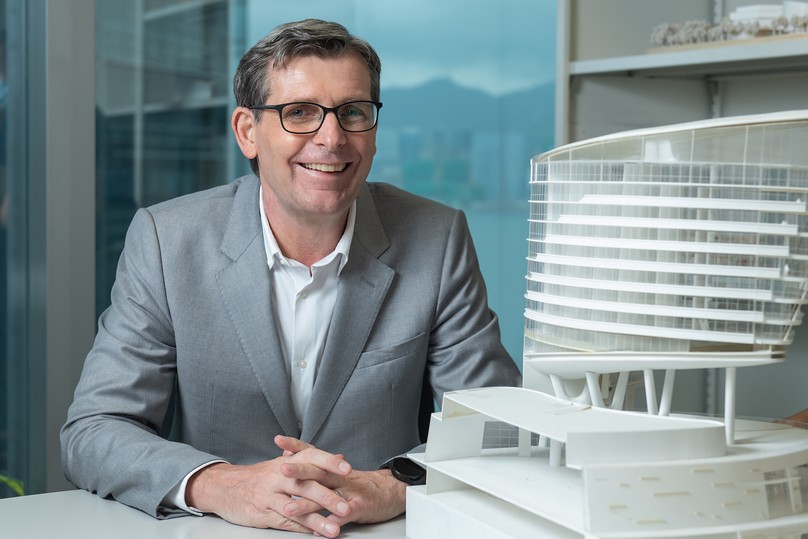
Stefan Krummeck is Global Director of Farrells
The piece is accompanied by visuals illustrating the proposed concept (further illustrations and diagrams are included in the attached zip folder). I believe it could resonate with your readers and contribute meaningfully to the city’s planning discourse. Full text and visuals are included below. I’d be grateful for your consideration.
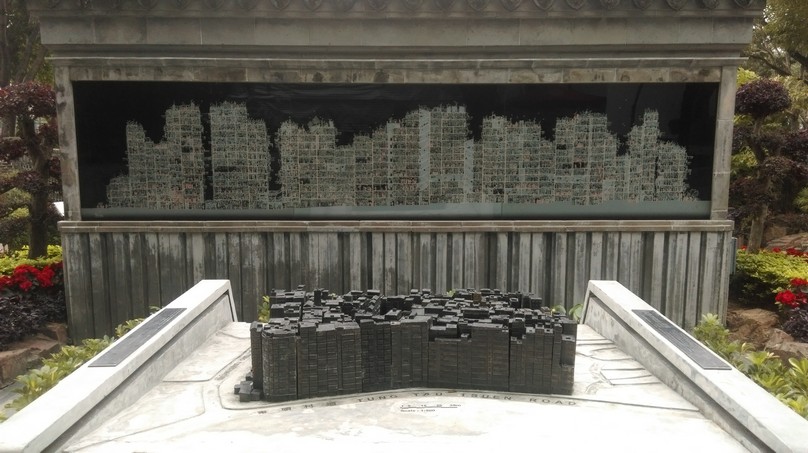
Figure 1 Kowloon Walled City – Wikimedia Commons 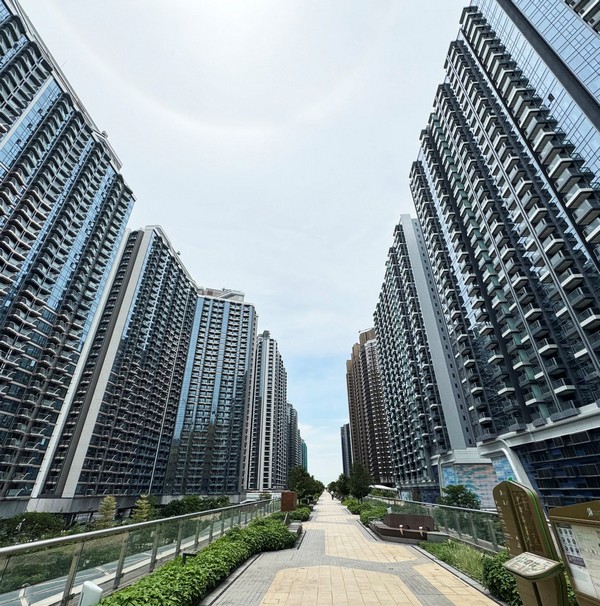
Figure 3 Kai Tak Wall Effect at the Sky Garden Level
The Beacon of Kai Tak: A Vision for Hong Kong’s Eastern Gateway
Hong Kong’s skyline is more than a feat of engineering — it’s a symbol of the city’s identity, ambition, and resilience. From the daring descent into Kai Tak Airport to the shimmering towers of Victoria Harbour, the city has long embraced verticality as a statement of progress. But as Hong Kong continues to evolve, so too must its urban language.
A less celebrated typology has quietly re-emerged: the “wall.” Historically, the Kowloon Walled City was its most extreme incarnation — dense, chaotic, and impenetrable (Figure 1). In more recent decades, developments in areas like Tai Kok Tsui have drawn criticism for creating similar wall-like structures that compromise air circulation, obstruct views, and diminish the human experience of the city.
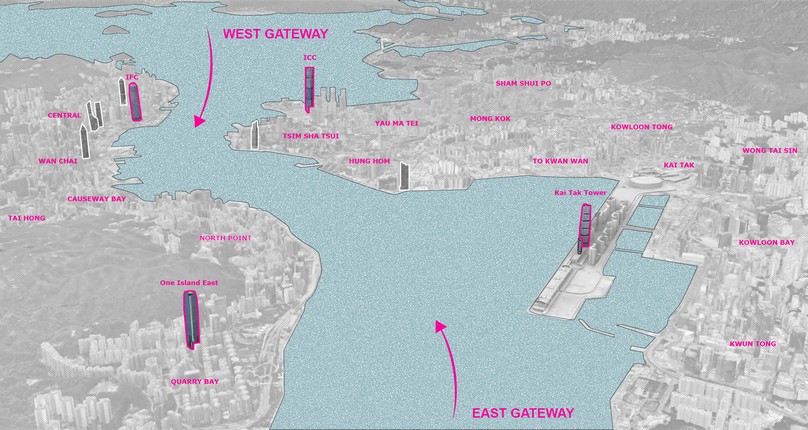
Gateway Towers Diagram 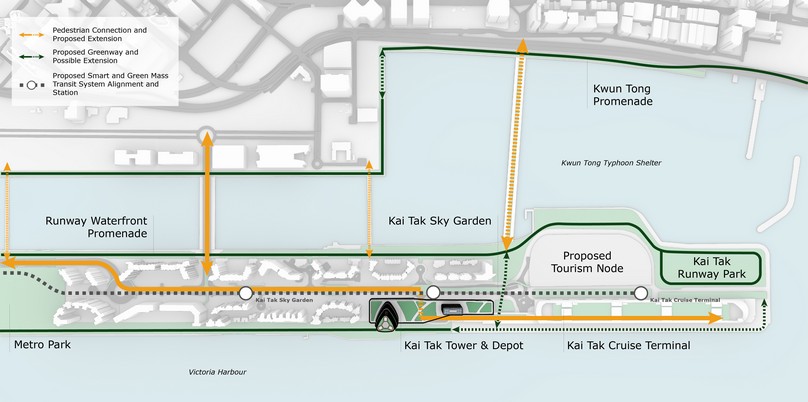
Diagram_Connections
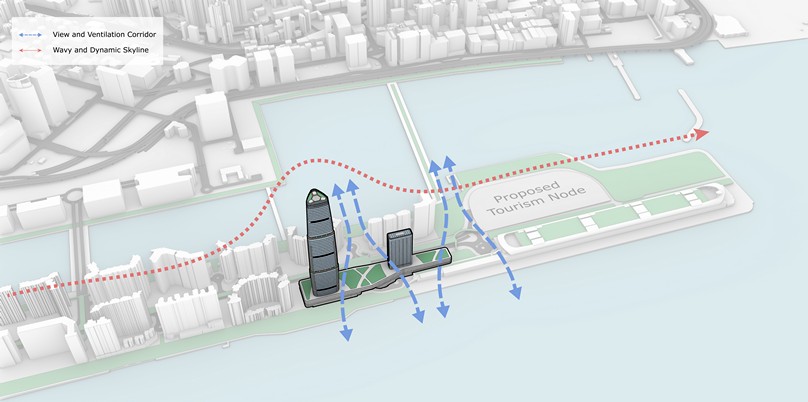
Diagram_View Corridors 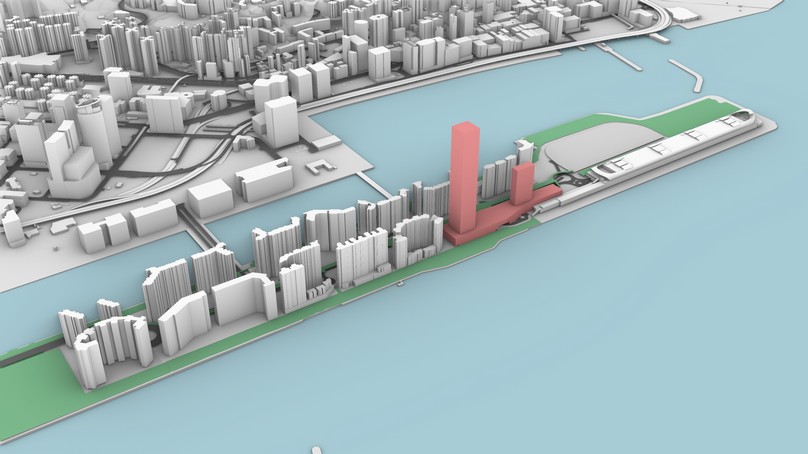
Diagram Landmark Tower
Today, this form is being replicated along the Kai Tak Runway, where two parallel residential blocks dominate the waterfront (Figure 2). From both Kowloon and Hong Kong Island, oblique views of Victoria Harbour are increasingly obstructed — a regrettable outcome for such a prominent site. But this is not a lament. It’s a moment to rethink.
Kai Tak runway is not merely an extension of Kowloon. With capacity for 30,000 to 40,000 residents, it is a mid-sized town in its own right — and it deserves an identity that reflects its scale, significance, and potential. The current trajectory risks repeating the mistakes of the past. Instead, we propose a strategy rooted in architectural clarity and civic ambition: a tripartite composition of low bar (Ocean Terminal), low blob (Kai Tak Stadium), and vertical insertion (The Beacon). This layered approach breaks the wall effect and restores visual permeability, spatial diversity, and urban character.
Cities thrive when their urban networks are intertwined with public parks and gardens — not as isolated green zones, but as part of a continuous civic fabric. At Kai Tak, the rooftop garden above the TOD adjacent to the Cruise Terminal presents a major opportunity (Figure 3): not just as a leisure space, but as a connective platform that links the waterfront to the central spine. Elevated, accessible, and civic in scale, it could become a hinge point between movement, landscape, and community — a gesture that stitches the city together.
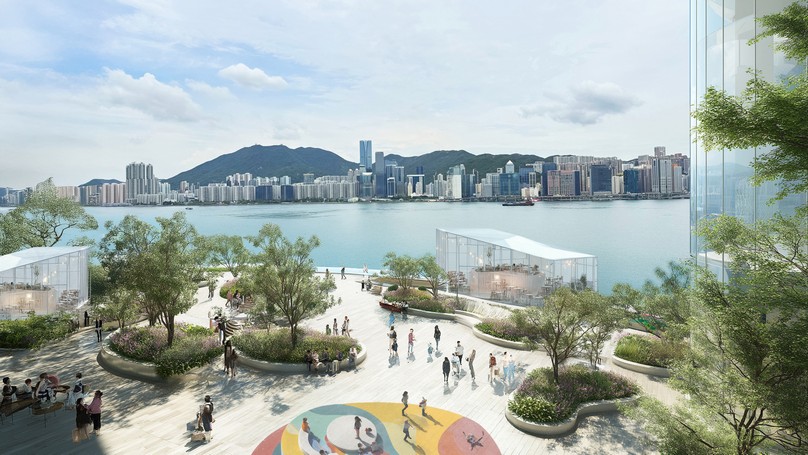
Kai Tak Tower Podium
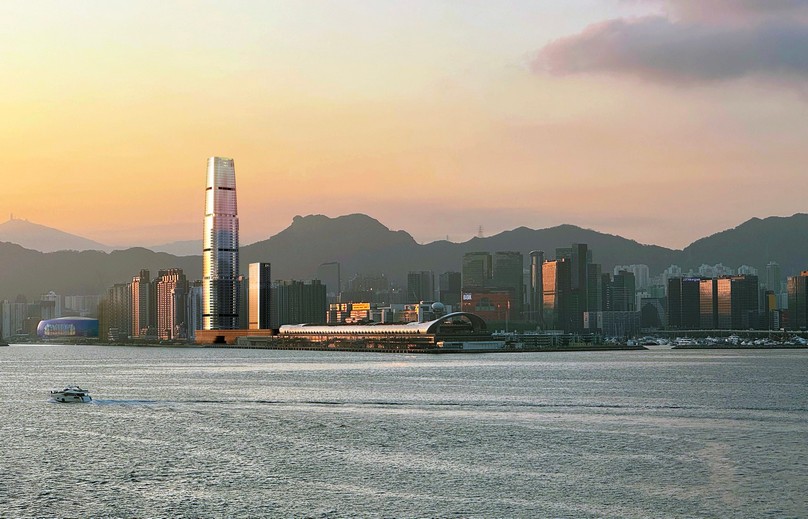
At the southern tip of the runway, we envision a tower development that acts as a modern “lighthouse” — a beacon of openness and possibility. Together with One Island East, it would form the eastern gateway to Victoria Harbour (Figure 4). With panoramic views, generous public spaces, and a design that prioritizes people over density, it could become a landmark destination and a symbol of Hong Kong’s renewed urban imagination.
This is more than a planning proposal. It’s a chance to honour the legacy of Kai Tak Airport — once a portal to the world and a source of collective memory — and to redefine waterfront living for the next generation. It celebrates openness, community, and the reassertion of Hong Kong’s identity: resilient, ambitious, and open to the world.