










• Net-Zero, Native, Necessary: Salma Tower’s Vertical Forest Rewrites the Office Typology

    28 February 2026

    In São Paulo’s concrete jungle, Salma Tower rises not just as a corporate landmark — but as a vertical forest engineered for regeneration, wellness, and net-zero ambition.

    Information and Images: aflalo/gasperini arquitetos 

    A Forest in the Sky

    In the heart of São Paulo’s Bela Vista district, Salma Tower redefines the commercial office typology. Designed by aflalo/gasperini arquitetos, this Triple-A corporate tower is not merely a workplace — it’s a suspended ecosystem, integrating 1,200 square meters of native Atlantic Forest across 16 floors. The smart building sets a new benchmark for biophilic design in the Southern Hemisphere.

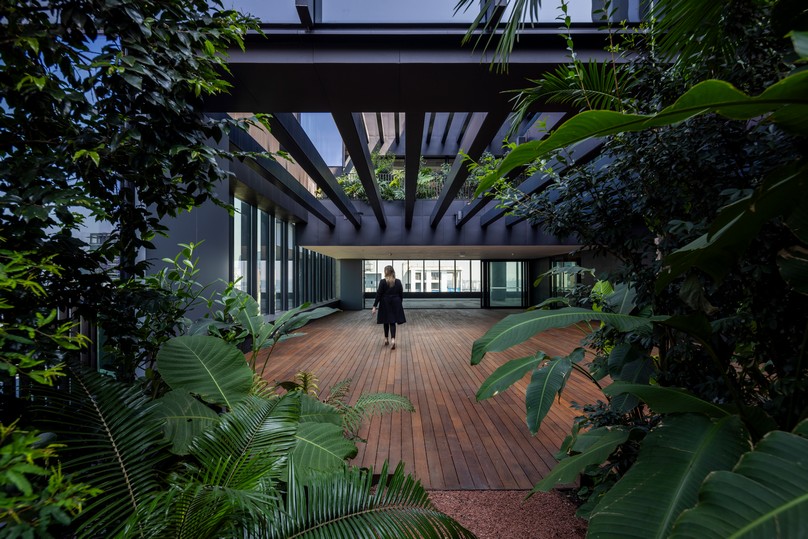
    The façade is more than a visual statement. It’s a living envelope. Spiral green terraces wrap the building’s core, creating a vertical forest that functions as both climate buffer and acoustic shield. These terraces — embedded with fruit trees and native vegetation — are not ornamental. They are engineered to regulate temperature, filter air and support biodiversity. The result is a building envelope that performs as a natural insulator, reducing energy loads while enhancing occupant comfort.

    Salma Tower’s LEED Platinum certification confirms its environmental credentials, but the innovation runs deeper. The building’s open ground floor — free of walls and railings — invites urban permeability. It connects three surrounding streets, activating the public realm with retail and hospitality. This gesture transforms the tower from a private asset into a civic contributor, aligning architecture with mobility and community.

    Envelope as Ecosystem

    The tower’s 80-meter height is articulated through 16 storeys, each with generous 4.68-meter floor-to-floor heights. This spatial generosity allows for double-height garden terraces that spiral upward, creating a continuous green ribbon. These terraces are not retrofits or add-ons — they are integral to the building’s structural and environmental logic.

    By leveraging São Paulo’s Terraces Law, the design dedicates 5% of the land area to hanging gardens. This legal framework becomes a catalyst for innovation, enabling the largest integration of native forest and urban architecture in Brazil. The building’s envelope is no longer a barrier between inside and out — it’s a porous membrane that breathes, shades, and shelters.

    The technical performance of the façade is matched by its sensory impact. A full-scale mockup of the forest terrace was built during design development to test light, airflow, and spatial quality. This empirical approach ensures that the building delivers not just metrics, but experience. Tenants encounter birdsong, forest breezes, and filtered light — elements proven to enhance mental health and productivity.

    A Model for Regenerative Workspaces

    Salma Tower is not a prototype. It’s a precedent. In a global context where commercial buildings are being re-evaluated for their carbon impact and human cost, this project offers a viable model for regenerative urbanism. It demonstrates that high-performance office towers can contribute to healthier inner cities and support the global quest for net-zero carbon.

    The building’s 36,616 square meters of area are distributed with precision, balancing density with openness. Its integration of landscape, architecture, and urbanism reflects aflalo/gasperini’s broader ethos — one that prioritizes environmental stewardship, mobility, and quality of life. With over 39 LEED-certified projects in their portfolio, the firm brings both legacy and leadership to the challenge of designing for a changing climate.

    Salma Tower is a commercial building, but its ambition is civic. It invites a new kind of tenant — one that values wellness, sustainability, and sensory connection. It’s not just about working in a forest. It’s about working with one, creating a place where productivity meets nature’s tempo, and where the skyline grows new roots.

    www.aflalogasperini.com.br

    More Features
    Three Decades of Design Leadership in Global Architecture
    Leading the Vanguard of Architectural Innovation In 2025, as NorthGlass celebrates its 30th anniversary, the company is accelerating its global expansion, writing a remarkable chapter in the advancement of China’s glass deep-processing industry. Established in 1995, NorthGlass successfully developed China’s first horizontal roller-type glass flat and bending tempering furnace with fully [...]
    The Architecture of Provocation: Frank Gehry’s Uncompromising Vision
    Frank Gehry (1929–2025) remains one of the most polarizing figures in contemporary architecture. Born in Toronto and based in Los Angeles, Gehry’s career spanned more than six decades, defined by a restless experimentation with form, material, and the limits of construction technology. His work is often labeled “deconstructivist,” though he resisted such categorization, preferring to [...]
    Sir Terry Farrell: A Legacy Etched into Hong Kong’s Skyline
    Sir Terry Farrell, who passed away on 28 September 2025 at the age of 87, leaves behind a built legacy that continues to shape the urban experience of Hong Kong and mainland China. Known for his contextual urbanism and postmodern flair, Farrell’s work in Asia was never about spectacle for its own sake, it was about place, people, and purpose. Farrell’s relationship with Hong Kong began in [...]
    The emergence of groundbreaking development, One Bangkok, is redefining the city’s urban landscape.
    Bangkok, a city renowned for its vibrant street life and bustling markets, is undergoing a transformation. PRC Magazine recently spoke with the team at Lead8, one of the firms involved in the development’s design, to delve into their vision for reimagining the retail experience at the heart of this new destination in Thailand’s capital. Urban Green – Lead8 Reimagines Retail at One [...]
    A Dynamic Fusion of Office, Retail, Public Space, and Transport by Arquitectonica
    GDH BCC: A New TOD Landmark in Guangzhou Located at the intersection of Huangpu West Avenue and Zhujiang West Road in Guangzhou’s Zhujiang New Town, GDH BCC stands as a bold architectural statement, redefining mixed-use development in one of China’s most vibrant business districts. Integrating Grade-A office spaces, an open-air retail village, and thoughtfully designed public areas, [...]
    Leigh & Orange Reimagining Campus Life at CUHK
    The Chung Chi Student Development Complex (CCSDC) is a visionary redevelopment project at Chung Chi College of The Chinese University of Hong Kong (CUHK). This initiative transforms two existing buildings into a dynamic hub for student life, blending environmental consciousness, student-centric design, and a deep respect for the College’s cultural heritage. The result is a forward-looking [...]
    Elevating Transit-oriented Design in Hong Kong SKYCITY Transport Terminal
    The SKYCITY Transport Terminal by architecture and design firm Lead8 is situated within the highly anticipated 11 SKIES development in Hong Kong and has established itself as the primary transportation hub for the newly unveiled SKYTOPIA airport district. With 16 franchised bus routes, taxi service lines, and additional transport facilities set to launch soon, the integrated transit terminal [...]
    Zhuhai Hengqin CRCC Plaza: Urban Connectivity and Integration
    Floating above the bustling coastal city, this architectural masterpiece embodies the harmony between nature and modernity. Its golden curves mimic ocean waves, while vast glass façades frame panoramic views of Zhuhai’s seascape and Macau’s skyline. Designed by Aedas Global Design Principal Dr. Andy Wen, Zhuhai Hengqin CRCC Plaza integrates ‘Loop, Communication, and Integration’ [...]
    Huangling Ancient Village: A Revival of History and Culture
    In the heart of northeastern Jiangxi, nestled among the rugged mountains and terraced fields of Wuyuan County, stands Huangling Ancient Village—an architectural gem shaped by time, history, and a profound commitment to preservation. Perched dramatically on steep cliffs, Huangling is a village where nature and traditional Hui-style architecture coexist harmoniously. Photography: SFAP With a [...]